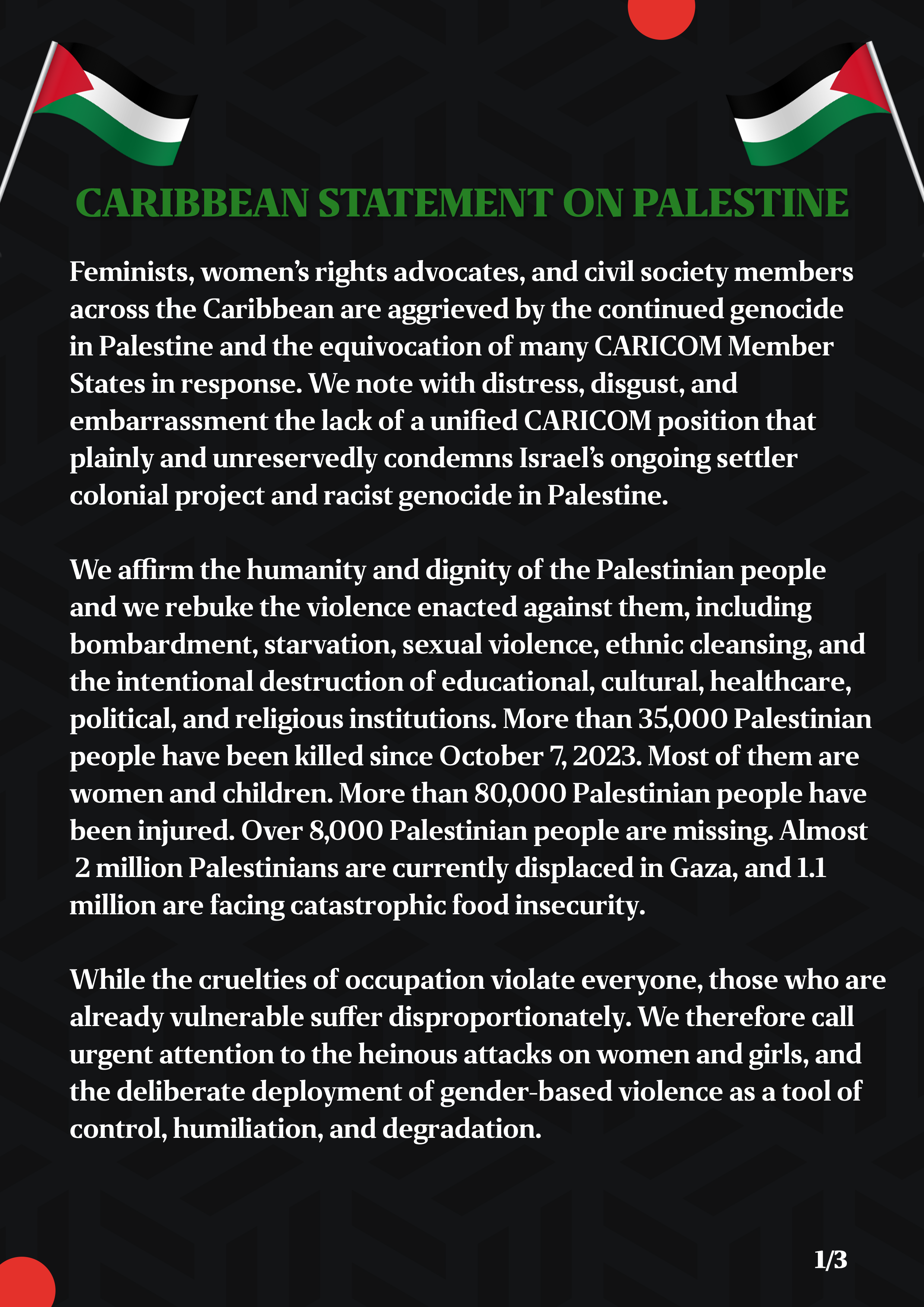
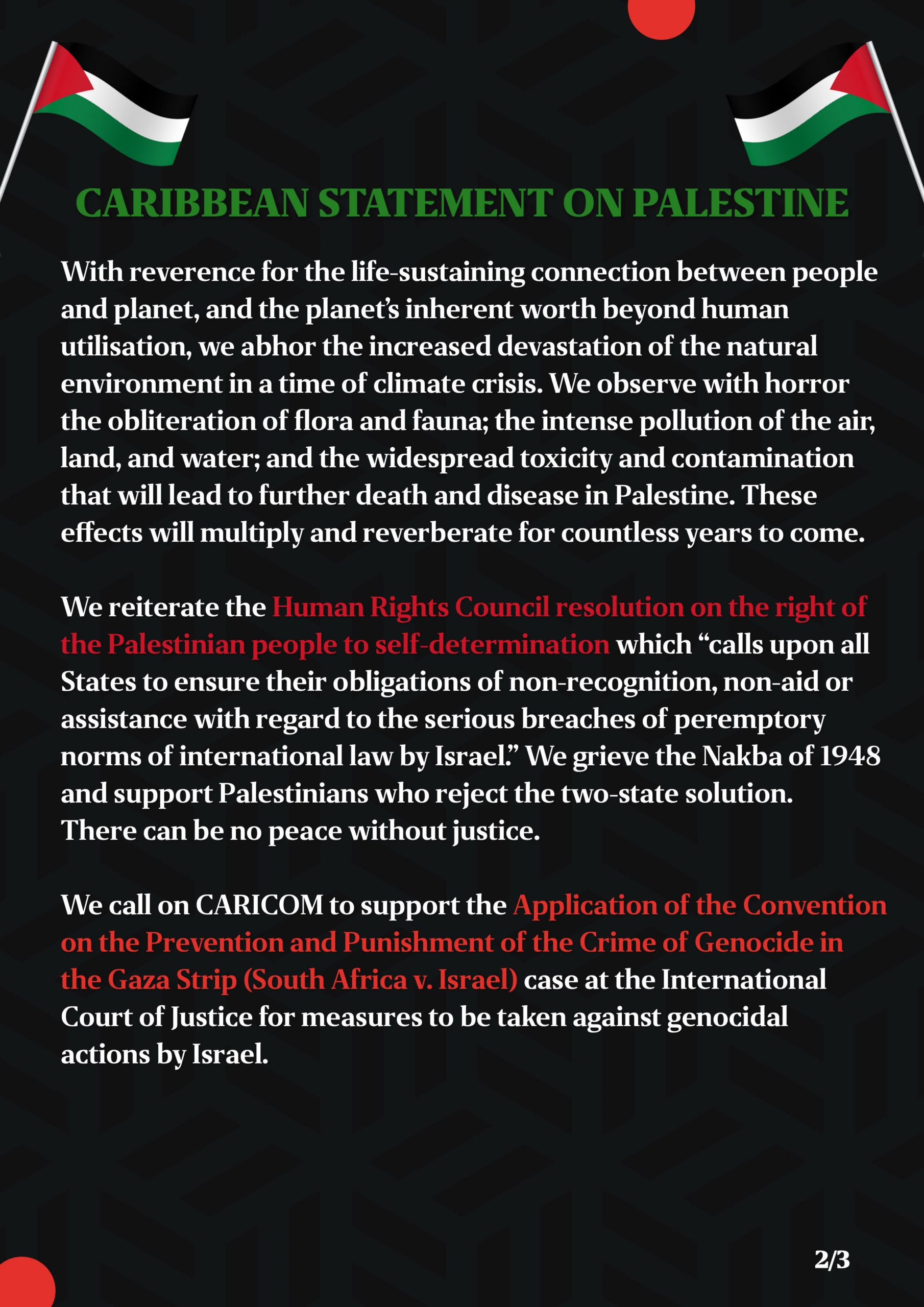
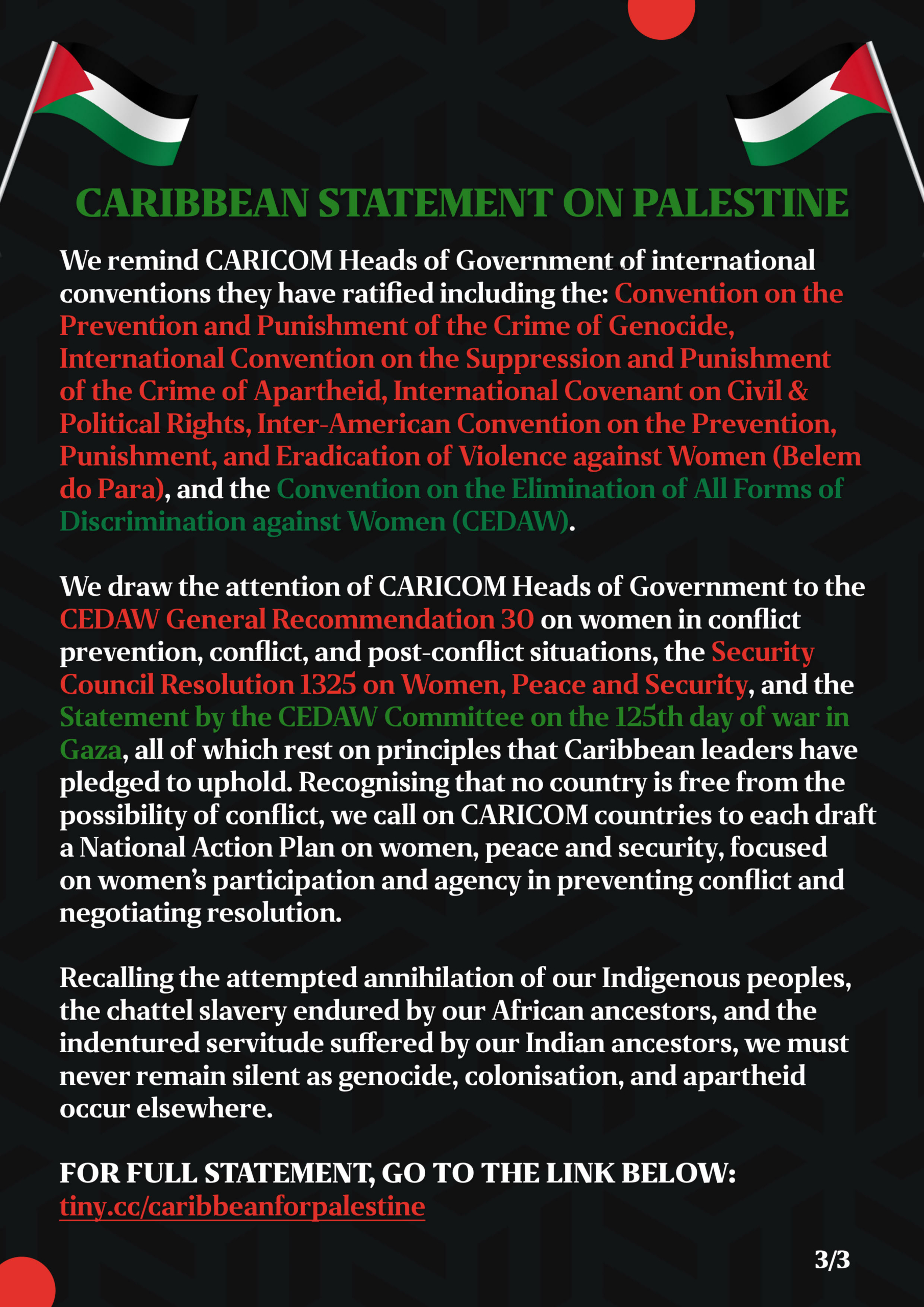
We are at the end of 2025 and people are thinking about the year ahead and all that they would like to achieve. Goals and resolutions are being set, and improved lives are being envisioned. There is significant focus on the self and the family at this time. In a few weeks, there will be increased attention on the country and its fate as related to the next general election. Zooming out from our immediate lives and geographic location, the global swing to the political right comes into view. The consequences have been and continue to be far-reaching. While it does not receive the necessary attention, the uninterrupted genocide in Palestine is one of the most horrific failings of our time, certain to reverberate all over the world and for many years to come. The refusal to see the connection between our struggles and the interdependence of our liberation is certain to determine our future. 


Even after more than two years of feigning or enjoying ignorance, today is a good day to start paying attention. It is a good day to commit to the development of a political ideology that does not discount the lives or the land of people we see as different or distance from ourselves, but demands solidarity with all people in situations of vulnerability. Our survival depends on it, especially as capitalism becomes more acceptable to the masses for whom it is devastating.  


At the United Nations General Assembly in September 2025, Special Rapporteur on the situation of human rights in the Palestinian territories occupied since 1967 Francesca Albanese said, “As I argued in my last report to the Human Rights Council, this genocide has become profitable, unfortunately, not just for some corrupt private entities. And this is not only Israel’s crimes. This is the world’s crime sustained by silence, complicity, and the supply of funds, weapons, and political cover. History, we’ll remember, because it’s not that this is the first genocide that is been known. No, the Holocaust, the genocide in Bosnia, the genocide in Rwanda were also known to the people of the time. But this genocide happened because the world didn’t care enough to stop them, like today, or not. But today’s genocide is something different. It’s openly incited, cynically denied, and relentlessly supported, armed, and weaponized, while those who oppose it are silenced, beaten, criminalized, and smeared. This is why I say this is the shame of our time and the collapse of the international legal order in this moment, not only for the Palestinians, but for all of us.”


In an October 2025 address to the General Assembly from Cape Town, due to U.S. sanctions preventing her participation in New York, Albanese said, “International law is clear: States must neither aid nor assist in the internationally wrongful acts of others, and must prevent and punish international crimes. This requires immediately suspending all military, economic, and diplomatic ties with Israel until its crimes cease, and pursuing justice for the survivors by holding perpetrators and accomplices accountable.” 


To close the perceived distance between us the Palestinian people who are experiencing the genocide perpetrated by “Israel” and the Palestinian people in the diaspora, fiercely advocating to the lives and the land of their people, it is important to listen to their voices. Their stories are the truth we need to hear and feel. 


Nour ElAssy

“Since becoming a journalist, my life has unravelled in real time. Every time I have found a new place to stay, the bombs have found me again. The signal bars on my phone flicker like a dying heartbeat, and when the battery dies, which is often, I scramble – desperately searching for even a whisper of electricity just to send a photo, a sentence, a single update. Sometimes, I have to walk for kilometres through shattered neighborhoods to find a generator or a hotspot. All while airstrikes roar above me.


“But I keep going. I take testimonies from mothers standing beside the corpses of their children. From fathers who haven’t eaten in three days and have nothing to give their starving kids. From children who draw tanks instead of flowers. And I send them out to the world, praying someone, somewhere, will read them and feel what I feel[…] Every time I zip up my vest, I remember the face of the photographer who was burned alive. The videographer who lost his family while filming the ruins of another. This vest is not armour. It is a shroud. But I wear it anyway. Because my people need someone to tell the world what’s happening. Because silence is complicity. Because if we stop speaking, no one else will.” 


Omar Suleiman

“Thousands of children are dead. Thousands of children are under the rubble. Thousands of children are missing limbs. Thousands of children are missing parents. Thousands of children are fighting disease. Thousands of children are having surgeries performed on them without anesthesia. Thousands of children have been starved. Thousands of children have been bombed out of their homes. Every single child in Gaza has been forever traumatized. All of the above are war crimes. We can keep letting human rights organizations count them. Or we can finally hold them accountable.”


Sumayah Abu Qas

“Ousamah begged me to let him go there to get food, but I refused. I was afraid of losing him. In the end, I gave in to my daughters’ hunger. On the morning of 19 June 2025, Ousamah went to the aid distribution center by al-Bureij R.C. in the Netzarim compound with my brother Ahmad and some other friends.  That whole day, I was scared and anxious. Then, at 11:00 P.M., my brother came back with Ousamah’s body. He was covered in blood and dirt. Ahmad told us an Israeli tank had fired a shell at them and hit Ousamah in the back, killing him and five others while they were opening boxes of aid. They all died on the spot.” 


Ahmad al-Ghalban 

“We started packing up our things with my uncle Iyad Salem, 33, and his daughter Hibah, 6. Around 2:30 P.M., as we stepped into the street with our things, the army fired shells, and one hit us. I was seriously wounded. Muhammad was dying next to me, and my uncle Iyad was torn to pieces. Hibah, my mother, my sister Alaa, and my brother Qusai were about ten meters away. I lay on the ground, bleeding. I looked at my legs and couldn’t believe what I saw. I told myself, “This is a dream.” My mother screamed and called for help. Five minutes later, a man arrived, and when he saw we were still alive, he put Muhammad and me in a tuk-tuk and took us to the Indonesian Hospital, along with my uncle, my mother, and the others.


“On the way, Muhammad recited verses from the Quran and the Shahadatain prayers [recited before death], but I didn’t realize he was taking his last breaths. At the hospital, I was taken into surgery right away. It lasted four or five hours. When I woke up from the anesthesia, I found out they had amputated both my legs and four fingers on my left hand. My right hand was also broken, and they put a metal implant in it. I had shrapnel all over my body. I stayed in the ICU for five days.

“I didn’t know Muhammad had died. I kept asking about him, but my mother said he was hospitalized in critical condition at a-Shifaa Hospital. She was afraid to tell me because I was in a very fragile physical and mental state. I kept telling her, “I want to see Muhammad.” And every time I asked, “Why don’t you go visit him?” she said the doctors wouldn’t let her. After two weeks, when I was doing better emotionally, she told me Muhammad had died. I cried a lot because Muhammad was a friend, too. He was my twin brother. I couldn’t believe he was gone. I cried nonstop for five days. I never imagined I would lose him, or that I would lose both my legs.”

Abir Hamza El-Khawaja

“We used to have lives and dreams. Despite the fact the Gaza Strip has long been besieged, right now, it’s completely desolate. All that exists is destruction. It’s become apparent that our dreams may not come true, such as the ultimate dream of visiting Jerusalem, or Akka, for example. But beforehand, we were able to enjoy simple pleasures: We could go to work in the morning; we could eat our favorite food; and we could quietly read a book. We could enjoy watching the sunset over the vast sea, and people could play with their children. We could then return to our families at the end of each night and to a warm bed, where we could enjoy a favorite drink, in peace. This security disappeared from that moment, and it seems it’ll never return.


“In previous Israeli military assaults on the Gaza Strip, most people would stay in their homes. We were inevitably suffering from all the death, destruction and incessant bombing, but this time, it’s not like that. It’s annihilation, displacement and starvation. This time, they’re really taking our lives.” 


Noura Erakat

“As a Palestinian, my heart is very broken that a genocide can continue, that Palestinian babies can be slaughtered and there is a debate over whether or not that’s OK or how it should be done better. As a Palestinian, I’m so frustrated that rather than take aim at the oppressive systems that placed us in these conditions, like prolonged military occupation, apartheid and genocide, that we are made into a problem to be resolved. We are not the problem. These conditions that oppress us are the problem and should be what the international community targets to destroy, rather than allowing us to be the target of destruction.”


Diana Safieh

“How do we handle this [survivor’s] guilt? Some struggle and do nothing, while others, occupied with their own struggles, cannot engage. However, many of us feel compelled to do what we can for those who cannot. Our activism is driven by the belief that our survival obliges us to fight for justice and the rights of those in Palestine. This constructive action is crucial for our own survival. And many of us, at home and abroad, seek comfort in those non-Palestinians offering their solidarity, through kind words, marches and other forms of activism. 


“I do not want to end on a pious note, and yet I will. It is one’s duty to take advantage of all the opportunities life presents to you to make the world a more hospitable place for all of us[…] We must use our privilege to work toward a day when life, liberty and the pursuit of happiness will be afforded to us all.”


Act to End the Genocide

Boycott, divest, and sanction. This is what we, who support human rights, abhor violence, and work for liberation, are called to do. It is as wrong as it is easy and lazy to assume a position of powerlessness. We can choose to seek information and use it to make decisions that, at the very least, minimize harm. The BDS movement is growing, and the organizers are providing easily accessible information to help participants to avoid giving money to “Israel” and entities that support it. Google, Amazon, AirBnB, and Disney+ are among the companies targeted by the economic boycott. More information is available at bdsmovement.net/campaigns#2. Make 2026 the year that you spend as if the lives of others depend on it. They do. 

“The State of Food Security and Nutrition in the World 2025 – Addressing high food price inflation for food security and nutrition”—published by the FAO, IFAD, UNICEF, WFP, and WHO—estimated that “between 638 and 720 million people, corresponding to 7.8 and 8.8 percent of the global population, respectively, faced hunger in 2024.” While hunger is expected to decrease between now and 2030, “512 million people are still projected to be facing hunger in 2030.” 

The FAO stated in “Latin America and the Caribbean Regional Overview of Food Security and Nutrition” that The Bahamas has a food insecurity rate of 17.2%. Food insecurity exists when people do not have access to enough nutritious food to support their growth, development for active, healthy lifestyles. The food insecurity rate in The Bahamas is cause for concern for many reasons. We know that there are noncommunicable diseases that are rampant in our population, affected by our diets and lifestyles. Many of us have also heard the stories of children going to school without having had breakfast and little or nothing provided for lunch. Food insecurity is directly related to poverty which not only affects people’s ability to pay for food, but the time to procure, prepare, and eat it. Taxation on food has negatively and disproportionately impacted people experiencing poverty, and there is little attention to this worsening issue. 

Addressing food insecurity requires a change in systems. While immediate, direct assistance is necessary until we reach a state of food security, it is not going to solve the problem. People need to be able to afford food. Both the import of food and the taxation on food are drivers of food insecurity. Combined with the lack of a livable wage, we have a dangerous situation. People are working full time, often holding more than one job, and still cannot afford to buy nutritious food. Some do not have a stove, and some do not have electricity. Many have to buy a few items every single day for their survival, unable to afford a “big shop” and/or unable to properly store food for more than one or two days. There are people who can buy enough food, but do not have the means (including time) to prepare it, so they opt for fast food or packaged food products. The circumstances vary widely, yet bring us to the same place. People are unwell, tired, underperforming, and stressed because of their inability to meet their most basic needs. 

When politicians come knocking, trying to secure your votes, ask them what they have done and what they plan to do to increase food security. Ask them what support through Social Services is like now, and how it will change in the coming five years. Ask them which schools have breakfast programs and which do not. Ask them how backyard farming will be encourage. Ask them about community gardens and food pantries in your constituency. Ask them about taxation, particularly on food. Tell them this is a priority issue, and that you need to see a plan for addressing it.

Between now and the point of food security, there are people who need help, and there are organizations working to fill the gap.


You can support:

  1. Hands for Hunger. This is a “humanitarian organization committed to the elimination of unnecessary hunger and the reduction of food waste through the creation of meaningful and engaging partnerships formed amongst all sectors of the Bahamian community” which engages in food rescue, food distribution, and education. Hands for Hunger operates a food pantry which enables clients to make their own selections from a variety of offerings. Donations can be made at handsforhunger.org/donate.
  2. Bahamas Crisis Center. This is a nongovernmental organization that provides free counseling services, particularly people experiencing domestic violence or related crises. It provides support to its clients beyond counseling, including through its food pantry. To donate, contact administration at 328-0922 to make arrangements.
  3. Bahamas Feeding Network. Thirteen organizations formed a group to “perform as a hub for the collection and distribution of food items and financial and physical resources to the entities that interact daily with thousands throughout the archipelago plagued with the uncertainty of knowing where their next meal is coming from.” Donations can be made at bahamasfeedingnetwork.org/donate.
  4. Soup kitchens. These are often operated by faith-based organizations. Find the one nearest to you and ask how you can help. From grocery shopping and delivery to serving and cleanup, there is no shortage of work to do.


Ways to Give

Cash. Few people seem to be willing to give money to people in need of assistance. Some want the gratification of purchasing items themselves and being able to give physical items. Some want to control what others—people in need in particular—consume, wanting people to have only what they deem acceptable. There is a serious people with the refusal to trust people in situations of vulnerability to make the best decisions for themselves. The fact is that people know what they need better than anyone else. Being able to purchase items themselves also prevents accumulation of individual products in excess, reduces storage issues, avoids issues with allergies and other dietary restrictions, makes healthier options possible, and allows for treats that might be otherwise overlooked. Giving cash recognizing people’s agency.

Gift certificates. An easy way to support people in different families and a wide range of situations is through gift certificates to grocery stores, pharmacies, and gas stations. This enables people to make the most appropriate selections available to them on an as-needed basis. At certain time of the year, like the holiday season in December, there is an increase in giving. There is only so much that each person and/or family can accept and consume in a short period of time. Gift certificates have a longer life, and make a great alternative to giving canned goods which are high in sodium. Those with cars appreciate the gift certificates for gas, enabling them to get to and from stores in addition to the school run, work commute, and job interviews. 

Fresh produce. When supporting a particular family or organization, be sure to include fresh fruit and vegetables. Onions, tomatoes, bell peppers, and lime go a long way in helping canned goods to reach their flavor potential. Bananas, apples, and oranges make great, quick snacks for everyone. If you have fruit-bearing trees, share the bounty. There is nothing quite like native fruit, and it is a special treat when discovered in a mix of necessities. 

Canned goods with manual can opener. When canned goods seem like the best option, remember to include a can opener to ensure that the people you are helping do not have an additional barrier. Choose a variety of canned goods. Be sure to include canned vegetables and beans. 

When people are sleeping in their cars and parked on lines for hours and hours to receive vouchers and food, it is clear that we have a problem. No one should have to do this for food. Sustainable Development Goal two is to end hunger, and 2030 is not very far away.

After seeing Entou Pearl Springer’s “Freedom Morning Come” on Emancipation Day in Trinidad, I posed its central question to people I know through friendships, scholarship, and activism. What you gonna do with your freedom? Everyone was intrigued by the question, where it came from, and where it would take them as they explored it. It seemed to be clear to every person I asked that there is no simple answer to the question. It is received with the weight of responsibility that is difficult to ignore. The question itself imposes a directive of sorts, and it is for us to determine what we are called to do with the freedom we have today. This week, I am sharing more of the responses I received to the question.

Freedom, privilege, and responsibility

One respondent pointed to the privilege that is inherent in certain versions freedom, and the fact that there is a division between people with varying degrees of freedom and privilege that leads people to act only in their own best interest, ignoring the plights of others.

They said: “A privilege that may come with freedom is the ability to turn your head away from other people, but true freedom comes with knowing that what you do in community matters. Colonisers used their freedom to oppress others to get more, but true freedom comes with responsibility to others, lifting each other up.”

Freedom to experience pleasure

Reflecting on this reality and their own freedom, they added, “I am using freedom to live my life with as much authenticity as possible—to love, to experience joy and pleasure, and to exist, even in the same space as bigotry and deliberate misinterpretation and abuse of the Word of God and abuse of other people. I am living with the determination to discover and harness pleasure and not apologise for it. I demand the freedom to exist within this duality and not expecting it to come with shame or an ax to drop at any moment. The freedom to see a slow-falling ax and still live as though it will never drop.”

Dawn Demeritte shared that she sees freedom as “a blessing to be able to do things that [her] ancestors had to fight to do”. She said: “I absolutely do not give in to capitalism if I can help it.”

Freedom, to Ms. Demeritte, is a way of life. She said: “When I wake up every morning, instead of rushing to get into the grind, I have a slow morning. I move at a ridiculously slow pace. I read a chapter of a book, I drink my herbal blend or matcha, I do my spiritual work, sometimes I sit on the balcony and just enjoy nature and then I slowly start my day. I rest when my body tells me to. I make time for joy, constantly filling the cup of my inner child. I let my senses guide my day.”

This is, of course, far from the reality of many. The freedom most of us have now is not absolutely or limitless, and it takes strategy, commitment, and specific action to build a life within which freedom can take this shape. There are still the everyday demands that come with living here, under the existing circumstances and with the specific needs and desires we have.

“I don’t restrict myself to certain experiences because that’s how it’s always been done. What’s good for a white person is good enough for me too. Don’t get me wrong I have responsibilities but I don’t let capitalism tell me how to live my life. I rest like it’s my birthright because it is. I work but when I’ve been sitting down for too long I close up and I go and live my life because I only have one shot to do it,” Ms Demeritte said.

Education as a path to freedom

Living as though we are free is a skill we need to build. It is one we have to practice. Freedom and lives of freedom look and feel differently from one person to another. We do not have all the same dreams. We do not all have the same responsibilities. There are places where our dreams and responsibilities intersect, giving us opportunities to work together, and there are places where we need to create what we want. This becomes more difficult as we get older and learn the ways of the world in rigid ways, believing they cannot change. It is important that children are equipped with the tools to imagine, to create, and to use their skills and ideas for themselves and one another.

Shara Goldsmith said: “With my freedom, I create diverse and equitable spaces where all children are respected, valued, and protected. With my freedom I advocate for the transformation of education and mental health institutions into holistic spaces of compassion and dignity. I am free, and so, I carve a path of acceptance, safety, and belonging, upon which others may trod together in community. With my freedom, I cultivate a life of purpose, peace, and play.”

Freedom to create change

As we gain greater access to education beyond the classroom, we receive information that is not a part of the national programming of citizens. It becomes more clear to us that the school curriculum is insufficient preparation for life anywhere, especially if we intend to do anything more than be cogs in the wheels of capitalism and colonialism. While everyone does not have the time and energy to challenge systems of inequality, there are people who are making intentional decisions in their study, work, and social networking to understand the world we are in what it takes to change it.

Ashawnté Russell said: “With my freedom, I’m fighting for justice, and not only the kind that lives in history books but the kind we must still claim today. I use it to push for climate justice in a world where those least responsible for the crisis bear the heaviest burdens. My freedom allows me to raise my voice for not just The Bahamas but the Caribbean, for the young end young at heart, for islands on the frontlines, for the communities whose struggles are too often ignored.”

“I walk in the footsteps of ancestors who couldn’t speak freely or with conviction,” she continued. “Now I sit at tables, organise across borders, and demand action from governments and global leaders. My freedom fuels this work, not just as a right I’ve inherited but as a responsibility I carry. True emancipation means not just surviving systems of oppression, but transforming them.”

Amber Turner said, “I am using my freedom to challenge systems that continue to deny freedom to others. Freedom, to me, is not just the absence of chains, but the presence of access to clean air, safe water, stable land, and a future you can plan for. I have committed my freedom to climate work, because the same colonial-era exploitation used to justify slavery is alive today in the exploitation of people and ecosystems.”

“I conduct research, communicate, and advocate for policies that address the needs of communities most affected by the climate crisis and who have contributed the least to it. I use my freedom to amplify the voices of those still fighting for theirs including marginalised youth, whose lives are impacted by environmental precarity. What am I doing with my freedom? I’m trying to make sure it’s not just mine,” Ms. Turner said.

Aneesah Abdullah said, “With my freedom, I will continue working to ensure that the rights, dignity, and voices of those on the margins—particularly religious minorities and underrepresented communities in The Bahamas (and on an international level). To the degree possible, I hope to continue to use my freedom to create/support the creation of space for all to be able to fully realize their human rights.”

Freedom to forge new paths

The freedom of our ancestors who were enslaved is different from the freedom we have now, and this means that we can and must use ours in new ways. Every generation has had to face daily challenges, look to the work of people before them for guidance, and envision a better, more equitable world. Every step forward requires acknowledgement of the past, respect for the people who struggled before and for us, and understanding the tactics used.

Tanicia Pratt said: “I’ve been using my freedom to connect with my ancestors, and do what they couldn’t. I don’t deny myself rest, joy, and self-expression. I dream about the world I want to live in and find ways of making that a small possibility now.”

Marjahn Finlayson said: “I’d go far as I can. See all I can see. My freedom looks different from my ancestors, but I’m building on the foundation that they laid out. Freedom from oppression in the form of slavery and physical labour to oppression in the form of white supremacist patriarchal capitalism. If I was free from the system, I would rest on the beach. I would teach.”

In the context that we live in, I imagine how it feels to fly while climbing a mountain,” Ms Finalyson continued. “Trying to live without fear and accepting consequences as they come when I do the right thing in my heart. The circumstances have changed but hundreds of years later, when I think about my enslaved ancestors, I think about prominent movements and leaders. Freedom comes from freeing others and ourselves.”

Published in The Tribune on August 13, 2025.

What you gonna do with your freedom? This is the question posed by Freedom Morning Come, a play by Entou Pearl Springer, performed in front of the Treasury Building in Port of Spain on the morning of August 1—Emancipation Day in Trinidad.

In the early hours of Emancipation morning, scores of people gathered to see the play. Freedom Morning Come is a play that depicts the day that enslaved people received the news that they were to be freed. The characters bore the names of enslaved people and told stories of capture, unsafe voyage, suicide, enslavement, violence, grief, and longing for both home and family. They began to look forward, imagining what life as free people would look and feel like. “What you gonna do with your freedom?” they asked one another, and the responses varied. At the end of the play, the question was posed to us, the audience, supposedly free.

This week, I shared this question with several people, inviting them to share their answers with me and with you. I found that people think of freedom in many different ways. Some focus on the freedom of today and making the most of it, some see that the freedom we currently have is still limited, some are acutely aware of the absence of freedom for others, and some think deeply about the duty they have to use their freedom for the benefit of other people.

Freedom realised

It is easy to take our freedom, however we view it, for granted. In asking people what they are going to do with their freedom, I have been exposed to the ways that some people are living in their freedom now and reveling in the ability to make decisions for themselves.

Here is what Myra M McPhee shared:

“What I have done with my freedom is such a profound question because of the nuanced nature of the definition of the word.

“Today, I am the freest I’ve ever been. I have a home, I am healthy, and I am loved by family and friends. I have the kind of freedom that allows me to travel whenever and wherever, I can schedule my annual doctor appointments a year in advance and schedule same-day virtual appointments, and I play Bahamian Citizenship Test games on Twitter with other Bahamians during business hours. I advocate for myself at work. I scream on behalf of others against systemic discriminatory laws. I create art. I am free free.

“My grandmother didn’t have the opportunity to go past the 6th grade and raised 12 children on John Street. My mother, a very smart woman with numbers and long-term planning, wasn’t able to go to college after her 12th grade year at Aquinas. Then there is me. I’ve earned 1 bachelor’s degree, 2 master’s degrees, and other academic accolades. My dreams and goals have not been limited. They have been fueled by my freedom and the sacrifices of the women in my family. I am free because my elders did way too much with way too little.

“I have the freedom of choice, comfort, and convenience. So with my freedom I choose to visit Nassau multiple times a year, I choose to be an artist and an administrator, I choose not to be stressed or hopeless. I am the kind of free that is committed to not missing birthdays, Mother’s days, or other special occasions. I am free to be present at the important moments.

“My grandmother and mother did the impossible with their limited freedom. With my boundless freedom, I choose to live a life the way I want. My existence is political, and yet I still thrive, because I cling to my freedom. It is a precious gift that I cherish every day.”

Freedom awareness

Do you have awareness, every single day, of your freedom? Some people are working to remember, to know, to act on their freedom on a daily basis, while trying to remind others of their own freedom.

“I have been using my freedom by trying to remember everyday that I actually have it. Some days, I feel like I am responsible to alert others to their own freedom and ensuring them access, but then most days that feels ridiculously self-important. I think I just have to make sure that I keep using mine. That I wring it out so that anyone watching can use it as an example if they desire,” said Niambi Hall Campbell Dean, PhD.

Can freedom and inequality coexist?

For some, it is difficult to contend with the idea of freedom while experiencing and witnessing various forms of inequality.

EW said: “I’ve been wrestling with the question of freedom a lot recently, especially regarding gender inequality. As a young Bahamian, it has often felt difficult— almost contradictory— to respect and appreciate the sacrifices our ancestors made for us to get to where we are today, while acknowledging and understanding that we still have a ways to go. Emancipation Day, among other holidays such as Independence Day, is a reminder that we did not always enjoy the liberties, rights, and freedoms that we at times take for granted today. It’s also a reminder of the power of people to join together, despite our differences, and achieve a common goal— one that realises better outcomes and conditions for those facing discrimination and oppression.”

“These observances should inspire us to fight complacency and discouragement and encourage us to channel our predecessors’ determination to make the changes we would like to see for ourselves and those who will come after us,” she continued. “On this Emancipation Day, I will take the time to reflect on the importance of collective action and justice and express my gratitude for those who made sacrifices for our freedom.”

Are we free while others are not?

By now, we are all aware of the settler colonialism, extractivism, and genocide that are constraining and erasing the freedom of people, and people themselves, all over the world. Anyone who is awake to these ongoing horrors and the failure of the international community to take action to stop them must think of those horrors when conversations about freedom arise.

“Free Congo. Free Haiti. Free Sudan. Free Palestine,” Orchid Burnside said.

Freedom as a tool to help others

Even for those who acknowledge that there is still a long way to go in experiencing and inhabiting freedom, there are ways to leverage the freedom we do have to support other people and to build a better world.

Kendria Percentie-Ferguson said: “With my freedom, I’ve chosen to serve. I use my voice and skills to advocate for justice, climate resilience, and equity, especially for communities that are often overlooked. To me, freedom means purpose. It’s choosing work that centers the vulnerable, challenges systems, and uplifts others. I’m still growing, still healing, but I try to use my freedom with intention every day.”

Dr Ancilleno Davis of @SciPerspective said: “I give others freedom. Through Science and Perspective, I teach youth and Bahamian communities how to use science to build their own body of knowledge so that they can in turn make the decisions their communities need. When information, science, education and choices are gatekept, it constricts the freedom of people. When we allow those affected by the choice the opportunity to learn what choices are being made, see and become involved in the processes used to make those decisions, and review the decisions before they are cemented, we strengthen the freedoms and the society we participate in.”

Is there freedom where there is no choice?

There is a freedom from and there is freedom to. One does not necessarily guarantee the other. A function of freedom is the ability to make a choice on one’s own, and true choice comes from the availability of options. There are ways that freedom may not be fully enjoyed due to the constraints of day-to-day responsibilities shouldered by individuals and groups that do not have the support of systems and resources that would enable them to exercise more free will.

When asked what they would do with their freedom, a person who will remain anonymous said, “Nothing, not a single thing. To me freedom is the power to choose from a place of want/desire and not need. As I sit here in an airport dreading my return to navigating adult diapers and incessant emails, only answer I got is nothing. I am going to do nothing with my freedom.”

What you gonna do with your freedom?

What about you? What you gonna do with your freedom? What have you done with it until now? If you would like to contribute to the responses that will be shared next week, send yours to shesubscribestostuff@gmail.com.


Published in The Tribune on August 6, 2025.

It seems to have shocked government officials and education administrators that 20 percent of teenagers have attempted suicide and 25 percent have considered suicide.

Teenagers who are struggling through the days of a high school that is not responding to their learning needs and hearing the national ridicule of them and their supposed inability to perform at the academic standards required. Teenagers who are responsible for their younger siblings and, in the absence of appropriate public services and support mechanisms, must take them to school, pick them up from school, prepare meals for them, and help them with their homework.

Teenagers who are preyed upon by adults, sexually assaulted, and blamed for the violence they experience. Teenagers who are forced to participate in crime lest they become victims of violent crime, then are characterised solely on their criminal affiliations and activities with no consideration of the the failure to prevent or intervene.

Teenagers who are bullied at school and either get no support from adults or never bother to report it because their first bullies were adults. Teenagers who are forced to work in order to meet the basic needs of their households, and are harassed, disrespected, and dehumanised at work, whether by employers, employees, or customers.

Teenagers who cannot participate in extracurricular activities because of cost barriers and/or the adult responsibilities they must shoulder. Teenagers who are harassed by people in positions of authority, including police, just because they are young and visible.

Teenagers who are experiencing changes in their bodies and their moods that they do not understand and for which they are punished. Teenagers who witness violence in their homes every day and live with the fear that they will one day return home and find a dead parent/guardian/sibling.

Teenagers who cannot identify a single adult they trust to listen to them and help them through a difficult situation. Teenagers who do not have access to mental health care and are, instead, told to pray, made to go to church, and/or sent to untrained or undertrained “counsellors” who cannot give them the support and tools they need to navigate the challenges they face.

Teenagers who struggle with addiction. Teenagers who are abused and told it is discipline. Teenagers who are beaten by adults who use them as punching bags on which they unleash their frustrations. Teenagers who carry the stress of “holding” illegal substances and weapons for people who have power over them. Teenagers whose homes are less safe than the street. Teenagers who can barely sleep at night. Teenagers who are keeping secrets no one should have to endure, much less refrain from ever speaking, preventing them from getting help. Teenagers who put their lives on the line in various ways that are ignored anyway.

The realities of young people are often ignored, sometimes discussed with complete detachment from the people involved, and almost never acknowledged — a requirement for appropriate intervention to take place.

Generalisations about young people are publicly made with little challenge. They are seen as unintelligent, troublesome, ungrateful, and even deserving of any misfortune that befalls them. They are well aware of the assumptions made about them, the accusations made against them, and the general sentiment toward them. Some of them even know that they are not all having the same experience, and that their race and class make a difference.

It is difficult for adults to understand themselves as having value and being worthy of love, care, and life itself. How much more difficult must it be for young people for whom even the shortest encounter is magnified and can feel devastatingly insurmountable?

Schools may now be focused only on academic development, but that is a missed opportunity and an injustice to the people — the children — it is meant to serve. School should not be a place for children to be spoon-fed information in order to regurgitate it while being molded into robots that do as they are told in order to be easily controlled when they enter the workforce. It should be a place for them to engage in learning, through the delivery of the curriculum and interactions with the people around them.

Children, including teenagers, need to connect with one another. They need to connect with their teachers. They need to learn to navigate relationships, to build trust, to identify unsafe situations, to work through disagreements, and to recognise the difference between what is normalized (and unsafe) and what is actually a normal situation or behavior.

Schools are a critical site for intervention. This is where irregularities should be most apparent. Teachers and administrators should notice the state of children’s clothing and hygiene. They should notice changes in patterns of attendance, behaviour in class, homework delivery, and testing. They should understand that the interest and effort of the child is not the only factor involved. Which children are sleepy? Which children are hungry or undernourished? Which children are showing signs of stress, anxiety, or depression? Signs that a child needs help can only really be investigated when there is a real relationship and trust exists so that the child can honestly answer questions.

Emotional intelligence needs to be a part of the curriculum, and it needs to be an area of focus in professional development for educators. All teachers and administrators need to be able to empathise with children. They need to be aware of their own beliefs and biases, and they need to know how to regulate their own emotions. They need to truly care about the children who are in their care, and help them to develop the skills to recognise their emotions and talk about them. They need to be trained in suicide intervention.

Children need to feel safe enough to share what is happening, especially when there is a chance that they will feel embarrassment or they fear that they will be punished for telling the truth (which may be framed to them as “private” or “family business”). Building this level of trust takes time and intention.

Children need to know that there is help available for them. If there is a free breakfast program, they should know where and when to go, and it should be easy to access. If there a mental health professional on staff, they need to know how to find them. They also need to be aware of the Department of Social Services and what can be accessed there. The assumption cannot be made that parents/guardians know or that they will initiate necessary processes.

Sometimes children are considering suicide because their lives seem untenable. Living does not seem worth it. It could be that they do not have the support they need. It could be that they think they are making life difficult for their parents/guardians. It could be that they are struggling to manage strong emotions. It could be that they need ongoing mental health support, without judgment. Life is not easy for all children. There are challenges they face, and many of them try to face them alone.

We need to ensure that the children in our lives know that they can safely talk to us and that we will help them through anything they are experiencing. Parents/guardians are not always able to provide all of the support that children need, and they may not notice that something is wrong. There are many reasons this could be the case, and there may be the desire to cast blame, but first, focus on the children. It is not their fault. As long as there are other adults in their lives, they should have attention, they should receive care, and they should be given the access to the resources and services that are life-affirming.

The statistics have been shared. The shock should have worn off by now. The concern should still be there. Action is needed. Mental health needs to be a priority. The curriculum needs to respond to the needs of the children, and educators need to acquire the skills to do the same.


Published in The Tribune on July 17, 2025.

Beware:
Ignorance
Protects itself.
Ignorance
Promotes suspicion.
Suspicion
Engenders fear.
Fear quails,
Irrational and blind,
Or fear looms,
Defiant and closed.
Blind, closed,
Suspicious, afraid,
Ignorance
Protects itself,
And protected,
Ignorance grows.
― Octavia E. Butler, Parable of the Talents
I have been thinking about the relationships between ignorance, fear, and hopelessness. Contending with hope is not easy. I have only been able to come to terms with it through the work of brilliant artists who present it as active and demanding. Hope is not something we get to just hold. Its utility disintegrates in lazy hands and multiplies as it moves through the hands of the activated collective.

One of our greatest challenges today—in the face of immeasurable destruction, genocide, and indifference—is to grow hope.

The next general election is just down the road and around the corner. The current administration is making promises and already signalling the need for more time to “continue” its work and the opposition is pointing fingers and asking questions. Political parties are starting to reveal their candidate slates as rumours about who will stay, who will go, and who will be newly nominated fly around.

Power struggles within political parties are coming to the fore. The media is in a state of perpetual readiness for stories of all kinds and sizes as it relates to internal political party issues, lambasting of one party by another, candidate announcements, and the possibility of an early election.

Partisan politics in The Bahamas is, by design, an absurd theatre that piques curiosity even in its monotony and predictability. Politicians are current and prospective employees of the Bahamian people. When they seek employment, they sing and dance, sing and dance, sing and dance.

Empty promises flow from their mouths with boring, repetitious, uninspiring rhetoric until they resort to name calling and lobbing accusations at others, punctuated by catchphrases and snippets of music that do nothing more than make people laugh. The employers are seated in the audience, eyes glued to the stage, watching the performance. Casting was done without their input. The stage was already set. All they can do is spend money at the concession stand and mindlessly eat and drink as they watch the show someone else selected.

Some audience members wonder what is going on backstage. Who wrote the script? Who is directing the cast? Why were these people even cast in these roles? Some notice the dark corners of the stage and try ‘to see what is happening where the lights are dim and the view of some performers is obscured. There is little room, it seems, for participation. Employers watch the show, waiting for the breaks between acts to discuss, make predictions, and argue with one another about the meaning of it all. Only when the show is over do most of the employers take their positions, ready to decide who will win it all with a single review—the vote.

When they are hired, the employees lose interest in pleasing their employers, even at the most basic level which, in our case, is putting on a show of dedication to the work that the employers—the people—want done. They take to the stage when it suits them, regardless of the presence of a waiting audience. The frequently show up unprepared, some never having attended a single rehearsal. It sometimes becomes clear that the employees fail to work together backstage before attempting another one-way engagement with audience. They sloppily deliver unplanned monologues and are thwarted by simple improv activities. They show that the backstage coordination is often nonexistent. They reveal their arrogance in their insistence on being a part of the performance, regardless of their levels of preparation. The stage, they believe, is theirs.

Once the prospective employees secure their positions, their already inadequate engagement with employers exponentially worsens. The performance required to get the job has depleted them, not only of energy, but the ability to pretend to care about the experience of the audience. If they sit in the theatre, in complete darkness, so be it. It is their own fault for expecting a show. The season is over. They should be grateful for the amateur hours that, from time to time, make use of the theatre space.

Politics can certainly take another form. There is the potential for the people, the employers, to reclaim power. It is entirely possible for the current and prospective employees to be held to a higher standard.

The existing system is dysfunctional. The existing practices disadvantage the people. Politicians see themselves as performers in a play, and they have no motivation to change the way they play their parts, much less commit themselves to affecting the reality that sits just beneath the fiction they use as cover. We, the people, know, to varying degrees, that what they see as a bit of fun amongst themselves is actually our lives. Allowing them to write the script and cast themselves and people like them is acceptance of ill fate.

The people vying for our votes are not leaders, and they are not trying to be leaders. They are satisfied to pretend. The fact is that we need representatives. One of our greatest struggles is that the people who get our votes—almost exclusively because we reject the people or the associated party running against them—do not know, care about, or ask us about the issues we face daily and need to have addressed. They do not live in our neighbourhoods. They seem to drive on different roads, present at different healthcare facilities, and send their children to receive a different quality of education than that which is available to us. We have to admit the self-governance and majority rule are not what we have when the people in parliament are not, in fact, like us. Worse, they prove, repeatedly, that they have no interest in even knowing what it is like to be us. If they did, they would engage us in the processes that have already begun ahead of the next general election. They are still more than comfortable with making a series of decisions with no input from the people directly affected by them, then turning to us with a singular question: This set of actors, or the other?

We need electoral reform. We need to know how political parties are funded. We need to be involved in the selection of candidates. We need to know when the election will be held, every single time, through a fixed date. We need to be assured that we will not have to endure the incompetence of any Member of Parliament for five years, equipped with a recall system. We need to be able to choose the best candidate in our constituencies without endorsing the leader of their political party to the prime minister. We need the boundaries to be set, not to be tampered with every five years. We need political quotas to reach gender equality in frontline politics. We need a modern system for voter registration and the tallying of votes. We need a national development plan that drives the agenda for every term and beyond.

We need a government that is led by the people. We need politicians who are the people, in every sense, and commit themselves to the highest good of the people, centring those in situations of vulnerability. We need to them to have integrity and be led it, and we need them to be discontented with the systems that do not serve us, such that they work together, with us, to build what we need rather than use the opportunity for personal gain.

At Women’s Wednesdays this evening, Equality Bahamas is facilitating a workshop designed to identify issues and develop recommendations to address them. There will be working groups on two thematic areas—social services and the environment. Members of the public are welcome to participate in one of the working groups at 6pm at the National Art Gallery of The Bahamas on West Hill Street. Register at tiny.cc/fbc2025.

Published in The Tribune on July 2, 2025.

Year after year, the Progressive Liberal Party sours national holidays that commemorate major achievements of the Bahamian people by claiming ownership, taking up an ordinate amount of space, and attempting to make them partisan.

Moments in Bahamian history are reduced, again and again, to a political party that relies heavily on its history—a far cry from its current state and demonstrated values—to maintain its fanbase and try to attract others. Majority Rule Day, Labour Day, and Independence Day all suffer the consequences of a political party—and a government administration—that prioritises being credited for historic milestones over national celebration, as one people, and creating opportunities for young people to learn more contemporary history of The Bahamas and for residents to advocate for the realisation of the benefits those achievements should have brought.

It is a loss for everyone when any political party seeks to dominate important days in the calendar year or tries to downplay the national significance of these holidays—days of observance—which is the repeated loss of opportunities to build a collective spirit, respect for our history and the people who made their mark on it, names known and unknown, and foster a culture of action by the people to create the change we need.

On Labour Day, it would be appropriate to acknowledge the wins of the labour movement and raise awareness of and garner support for actions as prioritised by workers.

What issues still exist in the workplace? What are the issues that are emerging now as society significantly changes, often outpacing the systems in place in the workplace? What needs of workers remain unmet? Which conversations have been “tabled” and never considered again? What are the relatively small demands that can be championed and actioned?

Labour Day is political. It ought to be political. The issue is that it is made into a partisan mockery, used to gain points and, near to general elections, to gain votes or excite party followers without doing an ounce of work.

In response to a question about social movements at a time of “American global hegemony, neoliberal economic relations, militarised counterinsurgency at home, and racial ‘colour blindness,’” speaking to both the US and global political climate in 2020, Angela Davis said, “I suggest that we need movements that pay as much attention to popular political education as they pay to the mobilisations that have succeeded in placing police violence and mass incarceration on the national political agenda. What this means, I think, is that we try to forge an analysis of the current conjuncture that draws important lessons from the relatively recent campaigns that have pushed our collective consciousness beyond previous limits. In other words, we need movements that are prepared to resist the inevitable seductions of assimilation.”

This is, of course, focused on the state of the US, yet we can take the recommendation that is at the root of the response. Popular political education is requisite to sustained organising.

People need to have an understanding of the conditions we live within, beyond the individual experience. Workers’ demands are not about the realities of one worker, the inequalities in one workplace, the violence of one employer, or the instability of one industry. It is about the ways that workers are regarded as a class and the understanding (and acceptance) of what is and is not considered work, what is and is not considered productive, what is and is not considered valuable, how value is assigned to tasks and the people who do them, who does and does not share in the profit, and what is and is not a safe environment.

A strong, sustainable labour movement spreads across industries, generations, and income levels, relying on political education to connect people. When systemic issues are identified and their characteristics known, the analysis of capitalism, racism, sexism, and xenophobia and their impact on labour is necessary, productive, instructive, and motivating.

The conversation is no longer about remote and hybrid in isolation, but about the commitment to systems that demand that employers or their agents lord over workers, controlling their tasks, the way they perform their tasks, and what they do beyond their tasks should they have the misfortune of appearing idle for five seconds.

This is not solely a drive toward greater productivity, but a breaking of will and conditioning of the worker to accept the dominance of another which is rooted in “isms” so many try desperately to ignore, pretending they are inconsequential in this place.

Collective consciousness does not just come about one day. It has to be built. It has to be nurtured. It comes from an understanding of history and the fact that the strides made in the 50s, 60s, and 70s were never meant to be the final steps. They were not the end of struggle, and they were not the last wins. They were always foundational, meant to be built upon by people who have information about what was done and how, now equipped with greater access to information and new technology to enable deeper analysis, more direct demands, and targeted actions to apply pressure to decision-makers.

On a podcast in 2022, Davis said: “I’m aware of the ways in which, especially in capitalist societies, there’s a tendency to focus on the individual at the expense of allowing people to understand that history unfolds, not as a consequence of the actions and the words of great individuals, but rather as a consequence of people coming together, joining hands, and uniting with their differences—not across their differences, but with their differences—in a quest to create more freedom and more happiness in the world.”

One of the stumbling blocks in any movement for change is the inability to work with differences. There is the refusal to acknowledge differences, there is the reluctant agreement to work together despite differences, and there is the alienation of people who are different in particular ways.

Working with differences is not easy. It requires, to an extent, solidarity. It demands that everyone face their own privilege and acknowledge the violence that others face as a result of the hatred of difference.

Standing together is a requirement. Across fields of work and across party lines, we must see the possibility of unity and the responsibility we have to build it. We must acknowledge it as a requirement for progress.

We have more common with one another than we do with the beneficiaries of capitalism and (low-)wage labour, and the differences among us are what show us all of the systems at play so we can develop tactics that target them all and benefit us all. We must submit ourselves to the learning process and be bold enough to engage in learning in public ways, enabling others to learn with us, grow with us, and join us in creating discomfort for those who are far too comfortable with the separation and the profit it drives to them every day.

Published in The Tribune on June 11, 2025.

On May 1, 2025, in what has been described as a “groundbreaking” moment in Caribbean frontline politics, Kamla Persad-Bissessar of the United National Congress (UNC) became the Prime Minister of Trinidad and Tobago. Perhaps even more interesting than this is the fact that this is the second time she has been elected to this position.

What makes this groundbreaking, then, is not that a woman now has the position of Prime Minister, but that woman hold the top three constitutional offices in Trinidad and Tobago. Pennelope Beckles-Robinson is the leader of the opposition, the People’s National Movement (PNM). Christine Kangaloo, who has been president since 2023, was responsible for swearing them in.

Last week, social media was full of posts by Caribbean people celebrating the moment, highlighting these three women in these three positions, asserting that it is not only progress, but an uncomplicated achievement. It is not unusual for social media posts to lack gender analysis, and it is not unusual for people to see numerical and proportional increases as synonymous with the true advancement of women. Quantity, as we all should know, is not quality, so there is more to consider.

Following the US presidential election, Persad-Bissessar, as the (then) Opposition Leader, made clear her position on the Biden administration. She said, “They focused on pushing a woke, extreme left-wing agenda that offended basic common sense and morality, overturned the norms of civilised public life, disoriented and mutilated children, censored and cancelled dissenting views, disparaged religious and conservative values, fuelled wars around the world, weaponised the judicial system against political opponents and increased nepotism, corruption, crime, poverty, homelessness, and wealth inequality.”

Persad-Bissessar went on to congratulate and celebrate the current US president. She said: “He has survived assassination attempts, political persecution, and years of personal attacks, but he triumphed in the end.” She added: “I look forward to the return of meritocracy, excellence, and intelligence as a standard criterion for accessing equal opportunities.”

This position is cause for concern for anyone who cares about and is committed to the achievement of gender equality and full access to human rights, especially for those in situations of vulnerability including women, children, LGBTQI+ people, people with disabilities, and people experiencing poverty, all of whom are disproportionately affected and deliberately targeted by the dangerous actions taking by the current US administration.

We do need more women in positions of leadership. We do need to reach gender parity in all levels of governments. We do need women to have decision-making power. We do need women to design and implement policies that move us toward gender equality. Women, however, are not all the same. We are not a homogenous group. There are women who benefit from existing systems of oppression and who are committed to maintaining their positions, even at significant cost to other women. There are women who do not want to be the woman to make the statement or take the action that demonstrates commitment to gender equality and the advancement of all women, often because it is more comfortable to come close to fitting in (with other leaders and decision-makers, the majority of whom are men).

Feminist advocates know this. This awareness is the source of the clear distinction between “women’s groups” and women who are political aspirants who call for more women in parliament and the feminist advocates who acknowledge the nuances and call for more feminist women and women who support women’s rights in positions of leadership at all levels.

Ahead of the 65th United Nations Commission on the Status of Women (CSW) in 2021, stakeholders from across the Caribbean worked together to develop a regional position on the theme, “Women’s full and effective participation and decision-making in public life, as well as the elimination of violence, for achieving gender equality and the empowerment of all women and girls.” The conversations had significant focus on women’s political leadership, ways to reach gender parity in frontline politics, and the markers of gender equality in leadership that extend beyond numbers and into outcomes, both for women and girls and for entire countries.

When gender equality and women’s leadership—particularly in the areas of political life and public life—is discussed, people focus almost exclusively on numbers. Just as there are difference among men in positions of leadership, there are differences among women in positions of leadership.

There are differences in beliefs and values, in skills, in leadership practices, in personal and professional interests, and in ideas and vision of success. It is easy for people to make assumptions about women in positions of leadership based on what they think they know. There are many gender stereotypes that are taken to be true, often entirely due to the frequency with which they are stated as though they are facts and the infrequency of them being refuted. Women do not all lead in the same way. Men do not all lead in the same way either. These facts do not necessarily change the longstanding ideas people have about the differences between women and men and what they mean for abilities and outcomes. This is a primary reason for the focus on gender, what it means, what it does not mean, and how it is used to limit opportunities.

Feminist advocates for women’s political leadership know that numbers are important. The call for women’s leadership in public and political life extends beyond women receiving nominations, getting votes, and being elected into office. It is for harmful gender ideology to be eradicated and social norms to change. It is for the creation of an enabling environment for women’s participation and leadership in public and political life. It is for increased positive representation of women in leadership in media. It is for early exposure to policymaking and spaces and processes. It is for the development of opportunities for women and girls to lead and conditions under which leadership by women and girls is supported, celebrated, and normalised.

Regarding the political moment in Trinidad and Tobago, Dr Gabrielle Hosein, lecturer at the Institute for Gender and Development Studies at the University of the West Indies St Augustine’s campus said, “In Trinidad and Tobago’s political history, having three different kinds of women leaders right now is unprecedented and historic.” Importantly, she noted that these wins are symbolic. “We have to see if they lead to ‘substantive’ wins, meaning approaches to governance that are less domineering and antagonistic and more inclusive and transformative, and create greater social, economic and gender justice,” she said.

Feminist advocates hold multiple truths. One is that women have the right to hold positions of leadership and decision-making power, and this is not contingent on any trainings or alignment on sociopolitical issues any more than is the case for men. Another is that the progress we need, particularly on women’s rights, gender equality, and social development, requires the participation and leadership of feminist women and women who are committed to working on achieving these goals, even in the face of great opposition, (from) wherever it rears its head.

This means that, just as many men in leadership are mediocre, women have the right to be mediocre in leadership. Just as men enter frontline politics without training, women can enter frontline politics without training. This, however, is not where the bar must be set. It is discriminatory to hold women to a different (and higher) standard than that to which we hold men, so must set higher expectations for all leaders while acknowledging the importance of increasing women’s representation to reach gender parity. This increases the visibility of women as leaders, demonstrates possibilities to young women and girls, normalises women’s leadership, and makes it possible for more women to take feminist positions not only at the personal level, but professionally, within the walls of parliament, cabinet, and the senate.


Published in The Tribune on May 7, 2025.

Systems are failing us all the time. These system failures lead to unfavorable conditions. They affect our daily lives. They affect our wellbeing. We have been, however, trained not ignore systems and to focus on the individual. We look for the ways that an individual has done less than their best, or the ways that we ourselves have somehow contribute to the situation we find uncomfortable, dangerous, or otherwise subpar.

We have a tendency to turn on and blame one another for failures rather than being attentive to the ways that systems malfunction or, in as is often the case, successfully degrade, endanger, subjugate, and limit us and our positive life outcomes.

Last week, someone posted in a popular Facebook group about the gates at public elementary schools being closed until eight o’clock in the morning. The person raised the safety issue this causes after a child “decided to jump in front of [their] car” and they slammed on the breaks to avoid hitting the child. They referenced recent events that let us know that there are safety concerns that must be considered with regard to school-age children. The post also included a note about the children failing to listen to the security guard before this change to the gate opening time was made.

The issue the post raised is valid. With the school gate closed until eight o’clock, when teachers are at work, there is a significant amount of time that children are outside of the premises and without supervision. Given the traffic on the road from seven o’clock to nine o’clock in the morning, the eight and nine o’clock start times for far too many jobs, the start time for school, and the inefficiency and safety issues of public transportation, parents are often forced to drop their children to school quite early to ensure that the children get to school on time and they are on time for work.

Somehow, many of the comments ignored the issue the person raised, instead casting blame on parents. Numerous people suggested that parents think it is someone else’s responsibility to supervise their children outside of school hours. Some referenced the disrespect and rudeness of children and the need for parents to better train and discipline their children. Others pointed out the school is not for babysitting children. A few noted that the eight o’clock opening of the gate is a Ministry of Education policy. These may all be interesting points that can explored further. The issue that remains is the inability of many parents to take their children to school at a later time or wait at the school until the gate opens. The options may be for children to miss school or to be there early, before the gate is open.

It a quite common for people to respond to systemic issues by imposing a set of rules or practices, however unrealistic, on individuals. There are sometimes ways that we can improve our lives and make more options available to ourselves, but we cannot bootstrap ourselves out of poverty and the same is true for other conditions that extend beyond our personal capacity to change.

There are many who cannot afford a one-bedroom apartment, not because they are unemployed, inept, or lazy, but because minimum wage is not enough money to live independently. People who are employed and unhoused do not need to be told to get jobs. They have jobs, and the problem is both the rate of pay and the incompatibility of the rate of pay with the actual cost of living. Reducing homelessness does not necessarily require job creation or helping people to find jobs, though this may be helpful for some. It requires a completely different approach to the remuneration of employees and the social services that should support people who are not paid enough to meet their basic needs. A shelter for unhoused people would be a great initiative, and it would not solve the problem. It makes for a good temporary measure while systemic changes are made.

In the case of the school gate opening at eight o’clock and the resulting situation of children being unsupervised and unsafe early in the morning, it may be useful for parents, administrations, teachers, and community members to get together and find a way to create a safe environment for the children who must be taken to school early. Opening the gate and having security to ensure only children and staff gain access may be considered ideal. Others may think there should be a “holding place” for the children before the gate opens, but this still requires adult supervision. We can think of many ways to address this issue on site, but the root of the issue would still be there. There is a system that needs to change.

School hours and work hours are not harmonised, and employers are not responsive to the needs of employees who are full human beings—not just staff, but have other responsibilities as family members and friends.

The 9-to-5 and 8-to-4 work schedule has taken root and become the standard, even in a country that is heavily dependent on the tourism industry (which requires shift work) along with other service industries. Many administrative job functions do not need to be performed during specific hours. Many businesses and customers would benefit from different open hours. There are numerous adjustments that can be made.

While New Providence is not growing in size, the number of cars on the road seem to keep increasing. Traffic is a mess almost all day, every day. It takes far too long to get from one place to another, all because of the number of cars on the road at any given time (and the ways they are driven). This can be alleviated with adjustments to the work day and overall flexibility in work schedules. Everyone does not need to be at work at eight or nine in the morning. Some can begin work at ten or eleven o’clock. We can go into detail about the ways this could benefit businesses, but it is really enough to recognise the benefits to workers and their families. That, on its own, is important, but it is not reflected in workplace practices because the priority is profit. That is the rule of capitalism, of course, yet we are all living in the world, living in this country, where we could all benefit from a better ecosystem, and that begins with support for families.

What needs to change with regard to the rights of workers? What do employers need to do differently? How can we make it possible for people to be as high-performing in their families as they are on their jobs? What have we accepted as normal or standard that need not be? How can we train ourselves to think beyond the individual, resist the urge to cast blame, and set about creating solutions that can be applied at the systemic level, for the benefit of all?

As we continue to navigate the challenges of a world that is unchanging in many ways, yet changing in ways that terrify and terrorize many, it is important that we remember the importance of community. We have a responsibility to be attentive, not only to individual and familial needs, but to the needs of the collective. We, as community members, need to actively care for one another, understanding the value of human life and the necessity of combining our efforts to assess problems, create solutions, and advocate for systemic change that is the responsibility of the people we elected to represent us.

National Poetry Month

April is National Poetry Month, so it is a good time to revisit favorite poems, pick up a book of poetry, or even put pen to paper to write a poem or two. To join the people participating in National Poetry Writing Month, send a message to Poinciana Paper Press on Facebook or Instagram to request an add to the WhatsApp group. The group will write a collective poem at Sovereign, the exhibition open at Poinciana Paper Press on Wednesday, April 9, at 6pm, and those in New Providence will meet at the National Art Gallery of The Bahamas on Sunday, April 13, at 2pm for a field trip that includes a look at this year’s National Exhibition and writing together.

“For Nothing Is Fixed” by James Baldwin

For nothing is fixed,

forever, forever, forever,

it is not fixed;

the earth is always shifting,

the light is always changing,

the sea does not cease to grind down rock.

Generations do not cease to be born,

and we are responsible to them

because we are the only witnesses they have.

The sea rises, the light fails,

lovers cling to each other,

and children cling to us.

The moment we cease to hold each other,

the moment we break faith with one another,

the sea engulfs us and the light goes out.

Published in The Tribune on April 9, 2025.