

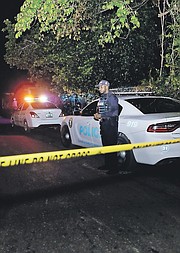
Over the past few days, in addition to the usual crime reports, there have been stories about the need to address what the prime minister called a “serious a chronic problem”.
Crime has plagued The Bahamas for a long time. Every government administration, upon arrival, blames it on the previous administration, and every Opposition blames the sitting administration for failing to find the solution.
While political parties blame each other to escape responsibility, members of the public convince themselves that the most violent crimes have nothing to do with them. It is often said that the criminals are killing each other, and some people go further to say this is a good thing. One of the reasons crime continues at high rates is that very few people and entities — including families, churches, and workplaces — are prepared to accept responsibility or take action to prevent it or intervene.
Violence does not come from nowhere. It is a learned behaviour. We all understand the threats of physical pain and death as a motivator. They can get a person to take or refrain from taking a particular action. Physical pain and death are understood as punishment. If a person fails to take or refrain from taking a particular action, especially after being threatened, they may be physically harmed or killed. This can be useful for learning not to, for example, touch fire because the direct consequence is the pain of being burned. It is unhealthy when fear is weaponised against a person. A person brandishing a weapon and giving a directive does not necessarily have to verbalise a threat for another person to understand that they must do as they are told to avoid being physically harmed or killed.
Unfortunately, children are taught, by example, to use other people’s fears against them very early in life. Children are beaten for any number of actions and inactions, including accidents. Get a bad grade, get beaten. Don’t finish dinner, get beaten. Spill juice on the couch, get beaten. Say a bad word, get beaten. Knock over a glass, get beaten. Text a boy, get beaten. Cry, get beaten. They are not only experiencing violence as a response to certain behaviour, but living with the threat of violence and how it shapes their behaviour. This is uncomfortable and feels as unsafe as it is, and it is training for abusing other people with the same tactics. Children learn that threats are scary, they can be made with or without words, and they can drive action. By practising the use of threats with their peers, they learn that anyone can do it.
When the issue or corporal punishment is raised, many parents become upset. Corporal punishment is what they know. It is the way they were “corrected” and “raised” by their parents, and it is what they use to “correct” their own children and any other minors in their care. They find the suggestion that it is wrong to be inconvenient. They do not like when it is referred to as violence. They see it as “discipline”.
Violence is “behaviour involving physical force intended to hurt, damage, or kill someone or something”. Corporal punishment, including the spanking, hitting, and pinching of children, is, indeed, violence. It hurts, and it can cause damage.
Discipline is “the practice of training people to obey rules or a code of behaviour, using punishment to correct disobedience.” Punishment is “the infliction or imposition of a penalty as retribution for an offence”. Interestingly, discipline has two components — training to obey and punishment as a response to failure to obey — and punishment is a response to offence. The response does not have to be physical, yet for many Bahamians, corporal punishment is the only familiar punishment. Perhaps it is that way because it is easy. It does not require thought. It could be that it is a generational practice that too many people are not prepared to question, challenge, or change, even when we know its association with slavery. More thoughtful, effective discipline takes thought and time. It is not immediate, and may require a cooling off period, so adults do not have the physical satisfaction of not only punishing a child, but offloading all of their frustrations in their delivery of corporal punishment.
Even before punishment is doled out, parents get it wrong sometimes. Maybe the believe the favorite child, and that child knows they can blame everything on their siblings. Maybe what parents perceive to be an act of rudeness is an accident. Maybe poor performance is not a refusal to try, but an ill-suited learning environment or an undiagnosed learning difference. When children are wrongfully punished, resentment can build. We know that there are angry people among us, and we do not know why. Some of them are still angry about the ways they were treated as children. Some people have mental health challenges because of the violence they experienced as children. Some are in unhealthy and abusive relationships because they were told all their lives that violence is love.
The crime we see in The Bahamas is not all due to violence against children. It is also not completely separate from it. We learn violence before we can speak. Years ago, ZNS played a recording of a child reciting “Children Learn What They Live” by Dorothy Law Nolte.
If a child lives with criticism, He learns to condemn.
If a child lives with hostility, He learns to fight.
If a child lives with ridicule, He learns to be shy.
If a child lives with shame, He learns to feel guilty.
If a child lives with tolerance, He learns to be patient.
If a child lives with encouragement, He learns confidence.
If a child lives with praise, He learns to appreciate.
If a child lives with fairness, He learns justice.
If a child lives with security, He learns to have faith.
If a child lives with approval, He learns to like himself.
If a child lives with acceptance and friendship, He learns to find love in the world.
That recording was played so often that many of us memorised it without trying. There must have been a reason ZNS played it. I do not remember it being preceded or followed by a public service announcement about child abuse, parenting, or anything of the sort. It may have been expected that the message would be received through repetition, but here we are. Child abuse continues to be called discipline, and people who lived with hostility and ridicule enact violence against people known and unknown to them.
The family is the first institution we know. It is where we learn behaviors we take with us through all of our lives, and some of us work hard to unlearn along the way. It is the place we are most easily and deeply scarred. It could be the place we learn to love and be loved, to treat one another with respect, and to believe in and value justice.
Will the government take a stand against corporal punishment? Will elders admit that violence is not the way to raise or discipline children, and that is has harmful effects? Will churches guide members in understanding metaphors and other literary devices so that “spare the road, spoil the child” does not become a license from god to abuse children? Will workplaces and other organizations support parents who need help balancing the work and family responsibilities, and to learn healthy parenting practices? We need all hands on deck. Everyone needs to participate in developing good, active citizens.
