Posts

Established by the Human Rights Council on May, 27, 2021, Independent International Commission of Inquiry on the occupied Palestinian territory, including East Jerusalem, and Israel (the Commission) collected and analysed evidence related to the occupied Palestinian territory and alleged violations of international law. Its report, “Legal analysis of the conduct of Israel in Gaza pursuant to the Convention on the Prevention and Punishment of the Crime of Genocide: Conference room paper of the Independent International Commission of Inquiry on the Occupied Palestinian Territory, including East Jerusalem, and Israel”, was published last week.

This is not the first report by the Commission. Previous reports “found that the Israeli security forces have committed crimes against humanity and war crimes in Gaza, including extermination, torture, rape, sexual violence and other inhumane acts, inhuman treatment, forcible transfer, persecution based on gender and starvation as a method of warfare”. It was also found that Israel “destroyed in part the reproductive capacity of the Palestinians in Gaza as a group, including by imposing measures intended to prevent births” and “deliberately inflicted conditions of life calculated to bring about the physical destruction of Palestinians as a group”.

The report notes that when a genocidal act is committed, there is a duty to punish the act. It references the Genocide Convention and the Rome Statute of the International Criminal Court, both of which define genocide. “The Rome Statute that established the International Criminal Court gives that Court jurisdiction to prosecute and punish individuals for the crime of genocide if committed on the territory of a State Party, regardless of the nationality of the perpetrator, or by a national of a State Party, wherever committed.”

The five categories of genocide, as laid out in the Genocide Convention and the Rome Statute are killing members of the group, causing serious bodily or mental harm to members of the group, inflicting conditions to cause physical destruction of the group, in part or whole, imposing measures to prevent birth within the group, and transferring children of the group to another group by force “with intent to destroy, in whole or in part, a national, ethnical, racial or religious group”.

The reports noted that at least 47 percent of Palestinians killed in Gaza since October 7, 2023 were women and children. It also found that 83 percent of Palestinians killed in Gaza were civilians. The World Health Organization (WHO) reported 498 attacks on healthcare facilities, killing 747 people in the Gaza Strip. It was found that women and children were specifically targeted and killed by Israel. “In all cases analysed by the Commission in relation to the attacks along the evacuation routes and within designated safe areas, the Commission found that the Israeli security forces had clear knowledge of the presence of Palestinian civilians along the evacuation routes and within the safe areas but nevertheless they shot at and killed civilians, some of whom (including children) 52 were holding makeshift white flags.”

The Commission reported on deaths resulting from the blockade on humanitarian aid, the increase in maternal mortality and neonatal and intrapartum deaths, and at least 1,373 people being killed while trying to access food. It stated, “Palestinians in Gaza were attacked in their homes, at hospitals, in shelters (including schools and religious sites), during the evacuations and in designated safe zones. At times, civilians, journalists, healthcare professionals, humanitarian workers and other protected persons were directly targeted and killed.”

The details in the report are damning and there could only be one conclusion. It concluded that “the Israeli authorities have committed the crime against humanity of extermination in the Gaza Strip by killing Palestinian civilians”. It stated that “the Israeli authorities intended to kill as many Palestinians as possible through its military operations in Gaza since 7 October 2023 and knew that the means and methods of warfare employed would cause mass deaths of Palestinians, including children”.

On page 16 of the 72-page report, it says, “The Commission concludes that the actus reus and mens rea of ‘killing members of the group’ under article II(a) of the Genocide Convention are established.”

The full report is available online, searchable by its title. It give a clear account of what has been taking place in Palestine and the irreparable harm caused to the Palestinian people. In the face of genocide, it is absurd that there continue to be calls for a two-state solution by anyone who is not Palestinian. Tremendous reparations are owed to Palestine and the Palestinian people, and it will take generations to repair the damage done to the land and the people.

As Rabea Eghbariah wrote for The Guardian: “The two-state solution has not only become detached from reality, but for too long steered the discussion away from reality itself[…] Just last month, Israel approved a plan for 22 new settlements in the West Bank. These decades of settlement expansion and de facto annexation have effectively gutted any viable basis for the two-state paradigm, even according to its own metrics.”

Eghbariah added: “The truth is that the two-state solution has become a delusion – a mantra repeated to mask an entrenched one-state reality[…] This mantra continues to prop up the illusion that Israeli occupation is on the brink of ending – if only more states recognize the Palestinian state and if only Palestinians and Israelis would just sit down and talk.”

Eghbariah clearly states that the two-state solution is fantasy and misdiagnosis. It ignores the foundation of what we see happening today, which is not a crisis, but a genocide. That foundation is the Nakba of 1948 and continued destruction of Palestine and displacement of the Palestinian people. There are questions that begin with the Nakba, including and not limited to its legal implications. The fantasy of the two-state solution comes from the idea that the “two sides” need only talk and come to an agreement, never having to reckon with the history of violence inflicted upon the Palestinian people and the justice due to them.

Opinio Juris shared commentary, in response to States recently recognising the State of Palestine, by scholars. Below are four excerpts.

“While two-state solution pontification is presented as pragmatism, it functions as a form of necropolitics, whereby one has power to dictate who is worthy of living. Salaita demonstrates that, when zionism is given oxygen to live, Palestinians are, by necessity, awarded the death penalty. Zionism can only thrive on the ruins of Palestinian villages and through the eradication of Palestinian natives, from the 1948 Nakba until the genocide of Gaza.”

– Bana Abu-Zulu

“Most obviously, the space between recognitions of the State of Palestine and the reality of Palestinian devastation, genocide, and catastrophe is so gaping as to swallow any declarations whole. It took declared famine for the recognising governments to speak at all; it is hard to imagine what would be needed to make them act. “

– Zinaida Miller

“As a child, I wondered why Europe didn’t see us and I would have been elated with this week’s declarations. As an adult, I understand that Europe still does not see us for us, but seeks to absolve itself of the guilt of having helped Israel’s extermination campaign. However, as a Palestinian, I know that our survival, resistance, and will to live provide all the recognition we ever needed.”

– Nawal Hend

“How can a state recognise Palestine without calling out Zionism for what it is? The two are clearly incongruous. A sincere recognition would entail all of the following: a) the creation of a multilateral conference for the consolidation and drawing of definitive boundaries of a Palestinian state; b) the establishment of an immediate peace-keeping mission for the inviolability of said borders and safety of its people; c) the imposition of intolerable sanctions on Israel and its isolation until at the very least the genocidal elements in its government are removed and meaningful relations with the new Palestine entity are restored; d) provision of unequivocal support to the International Criminal Court in its pursuit of justice; e) restoration of the life and dignity of the Palestinian people, both in Palestine proper and its diaspora.”

– Ilias Banters

The genocide is not deniable. It is happening, and it is being documented in realtime. The photos and videos give us imagery and the voices of the people reporting and sharing their stories give us limited insight into the way it feels to live through aggression, destruction, and murder. Palestine may seem geographically distant, but our struggles are connected. Colonialism, racism, and capitalism are known to us too. The Boycott, Divestment, Sanctions (BDS) movement needs more attention and greater, more dedicated participation. Visit bdsmovement.net to see the list of targets. Make the decision to stop spending money with corporations that fund the genocide. Stop enabling Israel. Stand with the Palestinian people.

Published in The Tribune on September 24, 2025

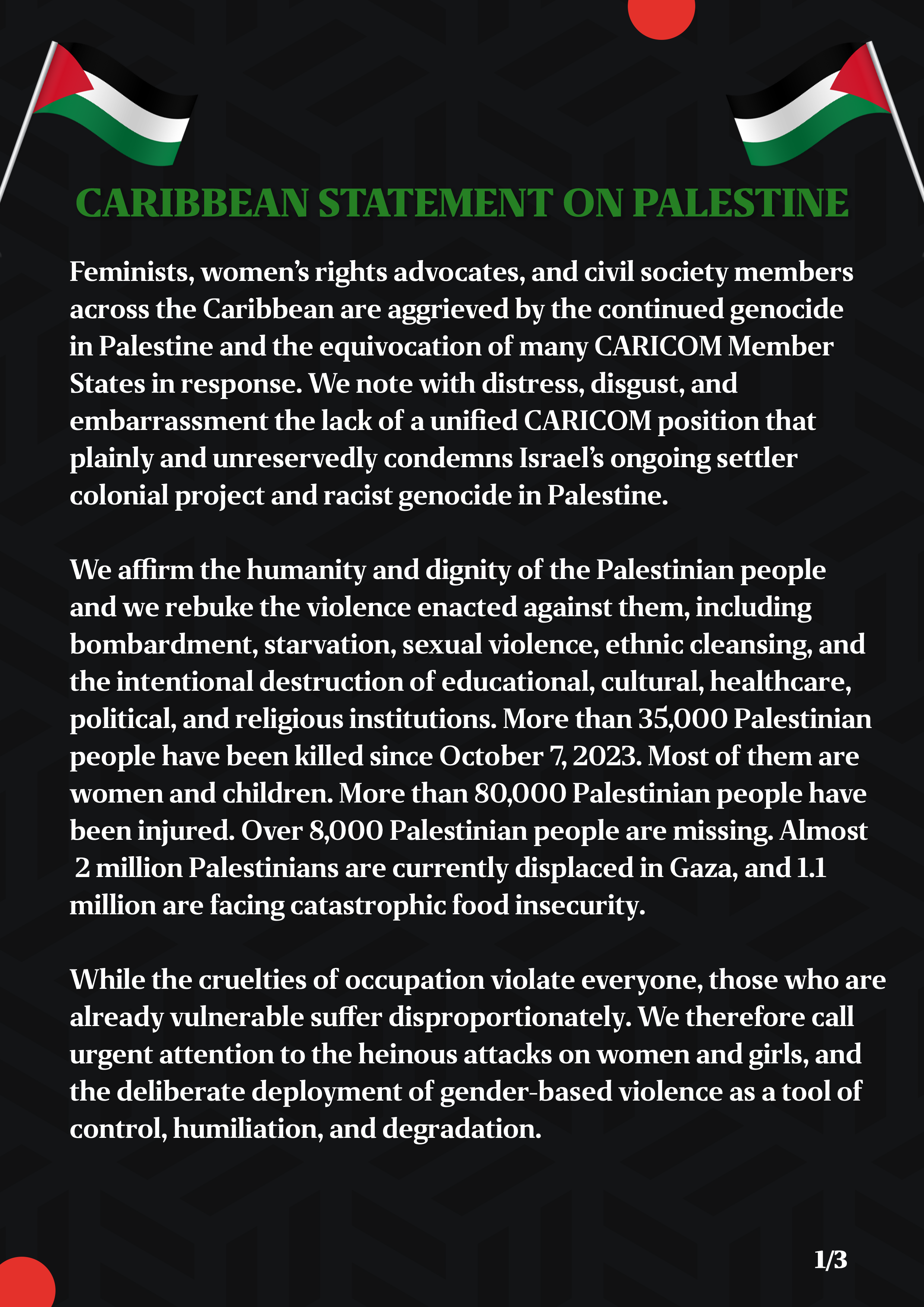
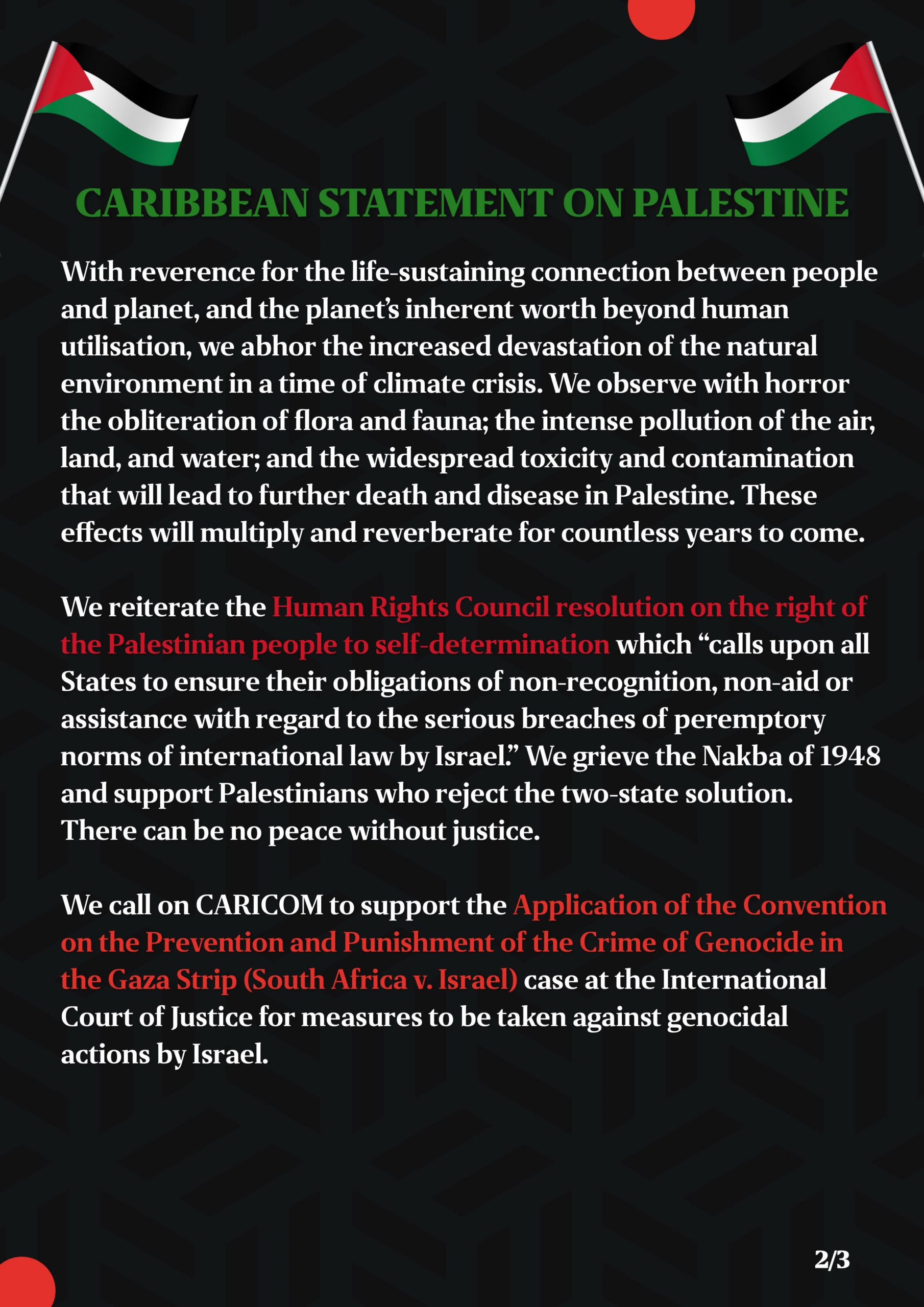
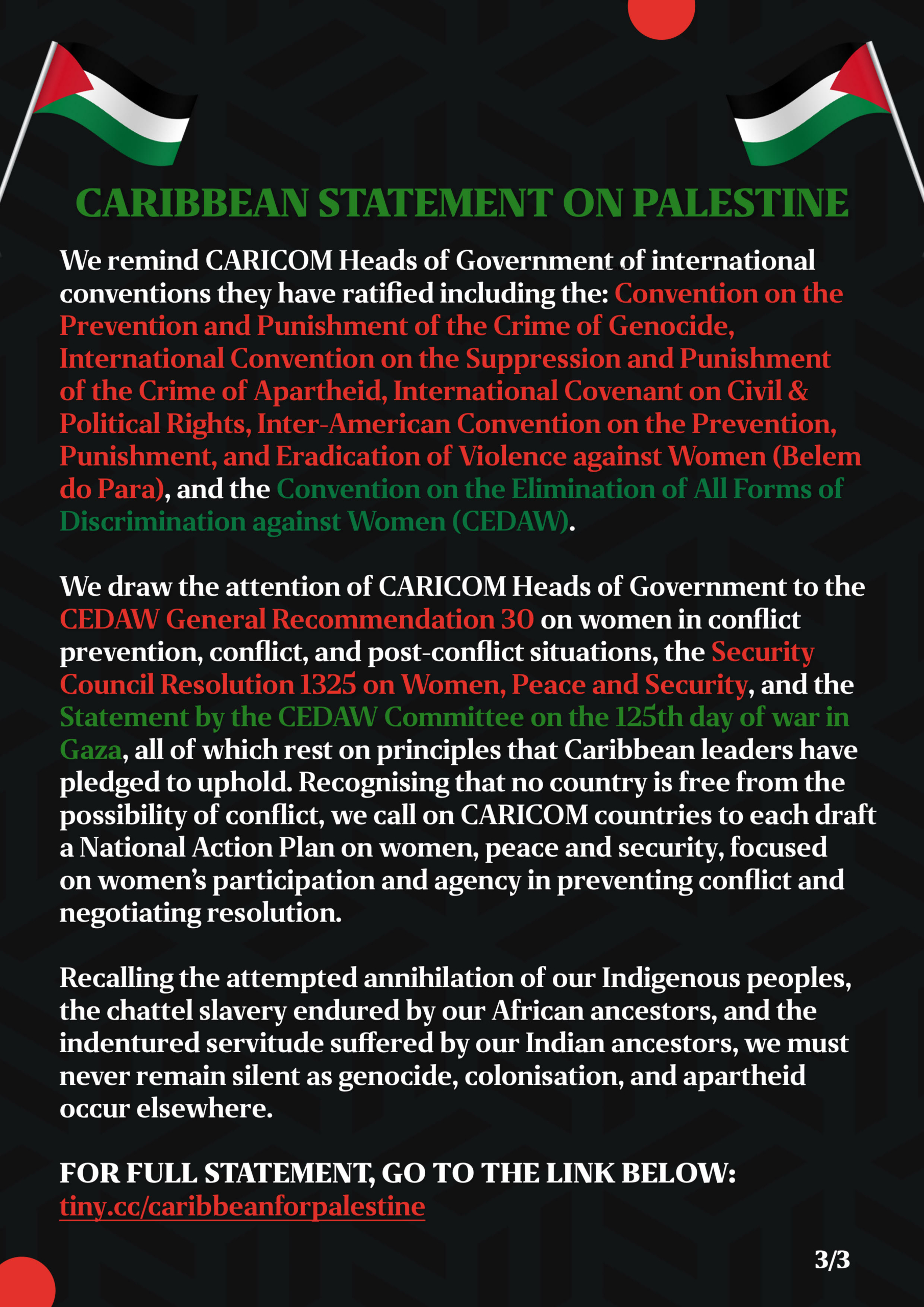
The Network of Caribbean Feminists released its statement–calling on CARICOM to support the Application of the Convention on the Prevention and Punishment of the Crime of Genocide in the Gaza Strip (South Africa v. Israel) case at the International Court of Justice for measures to be taken against genocidal actions by Israel–on the ongoing genocide in Palestine on Monday, May 7. This post has excerpts from the statement.

“We affirm the humanity and dignity of the Palestinian people and we rebuke the violence enacted against them, including bombardment, starvation, sexual violence, ethnic cleansing, and the intentional destruction of educational, cultural, healthcare, political, and religious institutions. More than 35,000 Palestinian people have been killed since October 7, 2023. Most of them are women and children. More than 80,000 Palestinian people have been injured. Over 8,000 Palestinian people are missing. Almost 2 million Palestinians are currently displaced in Gaza, and 1.1 million are facing catastrophic food insecurity.”

“We reiterate the Human Rights Council resolution on the right of the Palestinian people to self-determination which “calls upon all States to ensure their obligations of non-recognition, non-aid or assistance with regard to the serious breaches of peremptory norms of international law by Israel.” We grieve the Nakba of 1948 and support Palestinians who reject the two-state solution. There can be no peace without justice.”

See and share the full statement at tiny.cc/caribbeanforpalestine

THERE is always a crisis somewhere, and when there is a crisis anywhere, there is a crisis everywhere. This is the nature of the world, given the way that the global economy, geopolitic, and interpersonal relationships work on their own and are connected with each other. Crises, however discreet they may appear to be, are also interconnected. Discussed as though they are about one issue or another, armed conflicts are usually started to gain control of resources, destabilise economies, and/or oppress and subjugate people. The latter two are usually connected to the desire to steal, control, and profit from resources.

Some crises make it to the news while others are ignored, deemed less important, impactful, or relevant. Sometimes it is about the direct effect of crisis in one or two countries on the rest of the world and how much we depend on them for necessities. Sometimes it is about the people involved and how human the rest of the world considers them to be.

Everyone knows that there is a conflict in Ukraine, though everyone who is aware of it may not understand and discuss it as a war being waged by Russia.

We have seen footage of the violence against people and destruction of property. We have heard from the people who fled of the absence of choice and the will to survive which led to the separation of families. Ukrainian people have been forced to go to other countries that, thankfully, rightfully, accept them as refugees. They, in many ways, have to learn new ways of life, and they face the difficulty of deciding in which ways they should assimilate and in which ways they can and should maintain their culture. They balance the maintenance of their collective identity with living as comfortably in community with a receiving country. Language and food, of course, are integral to cultural identity, and are both the easiest and most difficult aspects to maintain when a minority in another country. Many have pointed to the targeted destruction of museums, galleries, and other cultural sites — clear attempts to wipe out every trace of Ukrainian cultural. This — all of it— is genocide. This is a war on people, on their culture, and on their history.

Everyone knows that there is conflict in Palestine, and particularly in Gaza, and there are different narratives about it, so not everyone acknowledges that it is genocide.

Some understand that Israel has inflicted violence upon the Palestinian people for decades, displacing them, trapping them in open-air prisons, and killing them. Some are unaware, and maybe uninterested, in the history of this crisis and the human rights violations by Israel against Palestine.

The same must be said here:

We have seen footage of the violence against people and destruction of property. We have heard from the people who fled of the absence of choice and the will to survive which led to the separation of families. Palestinian people have been forced to go to other countries that, thankfully, rightfully, accept them as refugees. They, in many ways, have to learn new ways of life, and they face the difficulty of deciding in which ways they should assimilate and in which ways they can and should maintain their culture. They balance the maintenance of their collective identity with living as comfortably in community with a receiving country. Language and food, of course, are integral to cultural identity and are both the easiest and most difficult aspects to maintain when a minority in another country. Many have pointed to the targeted destruction of museums, galleries, and other cultural sites — clear attempts to wipe out every trace of Palestinian culture. This — all of it — is genocide. This is a war on people, on their culture, and on their history.

What does the repeated use of these tactics tell us about these wars and the people waging them? What do they say about the intent of the people behind them? What about the common suggestion that it is “just about land”?

It is easy to throw our hands up. We can come up with countless excuses that amount to:

  • We are too far away.

  • We do not understand.

  • We are suffering too.

Whatever the excuses we can find to absolve ourselves of any responsibility for each other, within and across borders, global solidarity is critical. This has been rather difficult to build, but it is happening. One of the main gaps is the low capacity to care.

It is not always that people do not care. Sometimes people do not want to care, so they choose to ignore. Sometimes people do not know why they should care, and they actively work against the human instinct to be interested in the welfare of others. So many of us are tired, struggling, and tired of struggling. Moving from one day to the next can sometimes feel as though we ourselves are turning the massive, heavy hands of time, and that our running feet are what make this planet spin. The burden heavy, the pressure tall, we press on in our daily lives, concerning ourselves with what is immediately in front of us. Sometimes, being asked to care is taken as an affront. It is not that we should be blamed for these circumstances, considering that we are operating within a system that has been designed and maintained for this purpose — self-destructive individualism, hyper-focus on survival, perpetual exhaustion, and a seemingly necessary disinterest in what takes place outside of our own bubbles.

Our pushback against this system, while we are in it, has to be intentional, collective, and unrelenting. We have to choose to be attentive —watching, reading, and listening to the news. This on its own, of course, is not enough. We have to be media literate, assessing the credibility of our sources of information and being critical of the way the information is a delivered. Does the source have a clear position on this issue? What does the source want us to believe? Who has been quoted, and what other sources have been mentioned? What do the people behind this piece want us to do, and why?

One source is not enough for us to be able to make a decision on an issue. It is important to go to multiple sources, draw comparisons, note the contrasts, and verify the information. Are the stories firsthand, coming directly from people who have directly experienced the event? Is it a retelling of someone else’s story? Is there evidence to support the secondary data? What do the photos, video, and audio indicate? Could they have been manipulated in any way? Separate the facts from the opinions and apply the evidence.

After accessing and assessing the information for credibility, it can be helpful to discuss it with others. What do other people think about the news? Have others found other sources of information or completed assessments that we have not yet done? Do people tend to take one side over another? Why?

There is often one side that gets more support, and this does not necessarily mean that it is the right side. In many cases, the conservative viewpoints get more attention, both from media and from the people around us, because their talking points are generally the same and their positions are often so divisive that the media wants to run multiple stories over a long period of time, if only for the shock value that leads to more purchases and clicks. The people who call for human rights, dignity, peace, and equality are often left to play catch-up, responding to the hateful rhetoric and misinformation spread by other people. It is important to pay attention to what is being said on all sides and to identify the intent behind all of the messages. It is not sufficient to know the opinions people hold. Find out why they think, say, and do whatever it is they do. Assume less. Ask questions, challenge positions, and determine why you stand where you do.

Where are people being valued, championed, and protected? Where are systems and institutions being held up as more important than human life? Who is expressing concern and demonstrating care for the people most vulnerable to violence, destruction, oppression, and murder? Who is dehumanising people, using gender, race, socio-economic status, age, and other identity markers to “excuse” what is happening to them?

With information, opinions, and the intent behind them, we are better equipped to find our own positions on issues. Once we do, in order for it to mean anything, we have to take action. This does not mean we need to enter conflict zones or become participants in wars. Being relatively safe, we are able to speak up. We can talk to family members and friends about what is happening elsewhere and help them to understand who the victims are and how we can support them. We can make donations to organisations that are activated, especially on the ground and in receiving countries, to meet immediate needs, including food, water, and medical care. We can engage political leaders and other people of influence, sharing our positions and our expectations of them as they participate in conversations and decision-making processes with regard to the crisis. We can use our platforms, including social media, to share information and encourage others to act. Small acts matter. What is most important is that we take action based on our own capacity, and that we seek to increase that capacity by challenging ourselves and the systems that limit our ability and willingness to participate.

Interested in learning more about Palestine? Check out the list of 40 books at https://lithub.com/40-books-to-understand-Palestine. 

Published in The Tribune on November 15, 2023