Posts

After seeing Entou Pearl Springer’s “Freedom Morning Come” on Emancipation Day in Trinidad, I posed its central question to people I know through friendships, scholarship, and activism. What you gonna do with your freedom? Everyone was intrigued by the question, where it came from, and where it would take them as they explored it. It seemed to be clear to every person I asked that there is no simple answer to the question. It is received with the weight of responsibility that is difficult to ignore. The question itself imposes a directive of sorts, and it is for us to determine what we are called to do with the freedom we have today. This week, I am sharing more of the responses I received to the question.

Freedom, privilege, and responsibility

One respondent pointed to the privilege that is inherent in certain versions freedom, and the fact that there is a division between people with varying degrees of freedom and privilege that leads people to act only in their own best interest, ignoring the plights of others.

They said: “A privilege that may come with freedom is the ability to turn your head away from other people, but true freedom comes with knowing that what you do in community matters. Colonisers used their freedom to oppress others to get more, but true freedom comes with responsibility to others, lifting each other up.”

Freedom to experience pleasure

Reflecting on this reality and their own freedom, they added, “I am using freedom to live my life with as much authenticity as possible—to love, to experience joy and pleasure, and to exist, even in the same space as bigotry and deliberate misinterpretation and abuse of the Word of God and abuse of other people. I am living with the determination to discover and harness pleasure and not apologise for it. I demand the freedom to exist within this duality and not expecting it to come with shame or an ax to drop at any moment. The freedom to see a slow-falling ax and still live as though it will never drop.”

Dawn Demeritte shared that she sees freedom as “a blessing to be able to do things that [her] ancestors had to fight to do”. She said: “I absolutely do not give in to capitalism if I can help it.”

Freedom, to Ms. Demeritte, is a way of life. She said: “When I wake up every morning, instead of rushing to get into the grind, I have a slow morning. I move at a ridiculously slow pace. I read a chapter of a book, I drink my herbal blend or matcha, I do my spiritual work, sometimes I sit on the balcony and just enjoy nature and then I slowly start my day. I rest when my body tells me to. I make time for joy, constantly filling the cup of my inner child. I let my senses guide my day.”

This is, of course, far from the reality of many. The freedom most of us have now is not absolutely or limitless, and it takes strategy, commitment, and specific action to build a life within which freedom can take this shape. There are still the everyday demands that come with living here, under the existing circumstances and with the specific needs and desires we have.

“I don’t restrict myself to certain experiences because that’s how it’s always been done. What’s good for a white person is good enough for me too. Don’t get me wrong I have responsibilities but I don’t let capitalism tell me how to live my life. I rest like it’s my birthright because it is. I work but when I’ve been sitting down for too long I close up and I go and live my life because I only have one shot to do it,” Ms Demeritte said.

Education as a path to freedom

Living as though we are free is a skill we need to build. It is one we have to practice. Freedom and lives of freedom look and feel differently from one person to another. We do not have all the same dreams. We do not all have the same responsibilities. There are places where our dreams and responsibilities intersect, giving us opportunities to work together, and there are places where we need to create what we want. This becomes more difficult as we get older and learn the ways of the world in rigid ways, believing they cannot change. It is important that children are equipped with the tools to imagine, to create, and to use their skills and ideas for themselves and one another.

Shara Goldsmith said: “With my freedom, I create diverse and equitable spaces where all children are respected, valued, and protected. With my freedom I advocate for the transformation of education and mental health institutions into holistic spaces of compassion and dignity. I am free, and so, I carve a path of acceptance, safety, and belonging, upon which others may trod together in community. With my freedom, I cultivate a life of purpose, peace, and play.”

Freedom to create change

As we gain greater access to education beyond the classroom, we receive information that is not a part of the national programming of citizens. It becomes more clear to us that the school curriculum is insufficient preparation for life anywhere, especially if we intend to do anything more than be cogs in the wheels of capitalism and colonialism. While everyone does not have the time and energy to challenge systems of inequality, there are people who are making intentional decisions in their study, work, and social networking to understand the world we are in what it takes to change it.

Ashawnté Russell said: “With my freedom, I’m fighting for justice, and not only the kind that lives in history books but the kind we must still claim today. I use it to push for climate justice in a world where those least responsible for the crisis bear the heaviest burdens. My freedom allows me to raise my voice for not just The Bahamas but the Caribbean, for the young end young at heart, for islands on the frontlines, for the communities whose struggles are too often ignored.”

“I walk in the footsteps of ancestors who couldn’t speak freely or with conviction,” she continued. “Now I sit at tables, organise across borders, and demand action from governments and global leaders. My freedom fuels this work, not just as a right I’ve inherited but as a responsibility I carry. True emancipation means not just surviving systems of oppression, but transforming them.”

Amber Turner said, “I am using my freedom to challenge systems that continue to deny freedom to others. Freedom, to me, is not just the absence of chains, but the presence of access to clean air, safe water, stable land, and a future you can plan for. I have committed my freedom to climate work, because the same colonial-era exploitation used to justify slavery is alive today in the exploitation of people and ecosystems.”

“I conduct research, communicate, and advocate for policies that address the needs of communities most affected by the climate crisis and who have contributed the least to it. I use my freedom to amplify the voices of those still fighting for theirs including marginalised youth, whose lives are impacted by environmental precarity. What am I doing with my freedom? I’m trying to make sure it’s not just mine,” Ms. Turner said.

Aneesah Abdullah said, “With my freedom, I will continue working to ensure that the rights, dignity, and voices of those on the margins—particularly religious minorities and underrepresented communities in The Bahamas (and on an international level). To the degree possible, I hope to continue to use my freedom to create/support the creation of space for all to be able to fully realize their human rights.”

Freedom to forge new paths

The freedom of our ancestors who were enslaved is different from the freedom we have now, and this means that we can and must use ours in new ways. Every generation has had to face daily challenges, look to the work of people before them for guidance, and envision a better, more equitable world. Every step forward requires acknowledgement of the past, respect for the people who struggled before and for us, and understanding the tactics used.

Tanicia Pratt said: “I’ve been using my freedom to connect with my ancestors, and do what they couldn’t. I don’t deny myself rest, joy, and self-expression. I dream about the world I want to live in and find ways of making that a small possibility now.”

Marjahn Finlayson said: “I’d go far as I can. See all I can see. My freedom looks different from my ancestors, but I’m building on the foundation that they laid out. Freedom from oppression in the form of slavery and physical labour to oppression in the form of white supremacist patriarchal capitalism. If I was free from the system, I would rest on the beach. I would teach.”

In the context that we live in, I imagine how it feels to fly while climbing a mountain,” Ms Finalyson continued. “Trying to live without fear and accepting consequences as they come when I do the right thing in my heart. The circumstances have changed but hundreds of years later, when I think about my enslaved ancestors, I think about prominent movements and leaders. Freedom comes from freeing others and ourselves.”

Published in The Tribune on August 13, 2025.

What you gonna do with your freedom? This is the question posed by Freedom Morning Come, a play by Entou Pearl Springer, performed in front of the Treasury Building in Port of Spain on the morning of August 1—Emancipation Day in Trinidad.

In the early hours of Emancipation morning, scores of people gathered to see the play. Freedom Morning Come is a play that depicts the day that enslaved people received the news that they were to be freed. The characters bore the names of enslaved people and told stories of capture, unsafe voyage, suicide, enslavement, violence, grief, and longing for both home and family. They began to look forward, imagining what life as free people would look and feel like. “What you gonna do with your freedom?” they asked one another, and the responses varied. At the end of the play, the question was posed to us, the audience, supposedly free.

This week, I shared this question with several people, inviting them to share their answers with me and with you. I found that people think of freedom in many different ways. Some focus on the freedom of today and making the most of it, some see that the freedom we currently have is still limited, some are acutely aware of the absence of freedom for others, and some think deeply about the duty they have to use their freedom for the benefit of other people.

Freedom realised

It is easy to take our freedom, however we view it, for granted. In asking people what they are going to do with their freedom, I have been exposed to the ways that some people are living in their freedom now and reveling in the ability to make decisions for themselves.

Here is what Myra M McPhee shared:

“What I have done with my freedom is such a profound question because of the nuanced nature of the definition of the word.

“Today, I am the freest I’ve ever been. I have a home, I am healthy, and I am loved by family and friends. I have the kind of freedom that allows me to travel whenever and wherever, I can schedule my annual doctor appointments a year in advance and schedule same-day virtual appointments, and I play Bahamian Citizenship Test games on Twitter with other Bahamians during business hours. I advocate for myself at work. I scream on behalf of others against systemic discriminatory laws. I create art. I am free free.

“My grandmother didn’t have the opportunity to go past the 6th grade and raised 12 children on John Street. My mother, a very smart woman with numbers and long-term planning, wasn’t able to go to college after her 12th grade year at Aquinas. Then there is me. I’ve earned 1 bachelor’s degree, 2 master’s degrees, and other academic accolades. My dreams and goals have not been limited. They have been fueled by my freedom and the sacrifices of the women in my family. I am free because my elders did way too much with way too little.

“I have the freedom of choice, comfort, and convenience. So with my freedom I choose to visit Nassau multiple times a year, I choose to be an artist and an administrator, I choose not to be stressed or hopeless. I am the kind of free that is committed to not missing birthdays, Mother’s days, or other special occasions. I am free to be present at the important moments.

“My grandmother and mother did the impossible with their limited freedom. With my boundless freedom, I choose to live a life the way I want. My existence is political, and yet I still thrive, because I cling to my freedom. It is a precious gift that I cherish every day.”

Freedom awareness

Do you have awareness, every single day, of your freedom? Some people are working to remember, to know, to act on their freedom on a daily basis, while trying to remind others of their own freedom.

“I have been using my freedom by trying to remember everyday that I actually have it. Some days, I feel like I am responsible to alert others to their own freedom and ensuring them access, but then most days that feels ridiculously self-important. I think I just have to make sure that I keep using mine. That I wring it out so that anyone watching can use it as an example if they desire,” said Niambi Hall Campbell Dean, PhD.

Can freedom and inequality coexist?

For some, it is difficult to contend with the idea of freedom while experiencing and witnessing various forms of inequality.

EW said: “I’ve been wrestling with the question of freedom a lot recently, especially regarding gender inequality. As a young Bahamian, it has often felt difficult— almost contradictory— to respect and appreciate the sacrifices our ancestors made for us to get to where we are today, while acknowledging and understanding that we still have a ways to go. Emancipation Day, among other holidays such as Independence Day, is a reminder that we did not always enjoy the liberties, rights, and freedoms that we at times take for granted today. It’s also a reminder of the power of people to join together, despite our differences, and achieve a common goal— one that realises better outcomes and conditions for those facing discrimination and oppression.”

“These observances should inspire us to fight complacency and discouragement and encourage us to channel our predecessors’ determination to make the changes we would like to see for ourselves and those who will come after us,” she continued. “On this Emancipation Day, I will take the time to reflect on the importance of collective action and justice and express my gratitude for those who made sacrifices for our freedom.”

Are we free while others are not?

By now, we are all aware of the settler colonialism, extractivism, and genocide that are constraining and erasing the freedom of people, and people themselves, all over the world. Anyone who is awake to these ongoing horrors and the failure of the international community to take action to stop them must think of those horrors when conversations about freedom arise.

“Free Congo. Free Haiti. Free Sudan. Free Palestine,” Orchid Burnside said.

Freedom as a tool to help others

Even for those who acknowledge that there is still a long way to go in experiencing and inhabiting freedom, there are ways to leverage the freedom we do have to support other people and to build a better world.

Kendria Percentie-Ferguson said: “With my freedom, I’ve chosen to serve. I use my voice and skills to advocate for justice, climate resilience, and equity, especially for communities that are often overlooked. To me, freedom means purpose. It’s choosing work that centers the vulnerable, challenges systems, and uplifts others. I’m still growing, still healing, but I try to use my freedom with intention every day.”

Dr Ancilleno Davis of @SciPerspective said: “I give others freedom. Through Science and Perspective, I teach youth and Bahamian communities how to use science to build their own body of knowledge so that they can in turn make the decisions their communities need. When information, science, education and choices are gatekept, it constricts the freedom of people. When we allow those affected by the choice the opportunity to learn what choices are being made, see and become involved in the processes used to make those decisions, and review the decisions before they are cemented, we strengthen the freedoms and the society we participate in.”

Is there freedom where there is no choice?

There is a freedom from and there is freedom to. One does not necessarily guarantee the other. A function of freedom is the ability to make a choice on one’s own, and true choice comes from the availability of options. There are ways that freedom may not be fully enjoyed due to the constraints of day-to-day responsibilities shouldered by individuals and groups that do not have the support of systems and resources that would enable them to exercise more free will.

When asked what they would do with their freedom, a person who will remain anonymous said, “Nothing, not a single thing. To me freedom is the power to choose from a place of want/desire and not need. As I sit here in an airport dreading my return to navigating adult diapers and incessant emails, only answer I got is nothing. I am going to do nothing with my freedom.”

What you gonna do with your freedom?

What about you? What you gonna do with your freedom? What have you done with it until now? If you would like to contribute to the responses that will be shared next week, send yours to shesubscribestostuff@gmail.com.


Published in The Tribune on August 6, 2025.

Bishop Simeon Hall recently called on the church to take a stance against sexual violence, specifically including acts within families and marriage. He made a distinction between the desire for sex and the attempt to gain power which leads to sexual violence. Hall also correctly made the connection between the dehumanisation of women and failure to see us as valuable people, noting society must value women in order for sexual violence rates to go down.

We need more leaders of the church to not only “boldly decry” sexual violence, but to implement programmes and policies that address the issue and support survivors. Hall encouraged women to report to the police, seek medical care, and take their time to heal. These are all important to hear, particularly for women who have been taught their wellbeing is worth less than the reputation of male relatives.

Many churches have men’s groups and women’s groups. Are they talking about sexual violence, making a distinction between sex and rape, making members aware of available resources, and advising of the support they can expect from the church and its leadership? They need to do all of this, but also to sensitise members to the issue and encourage them to support survivors and refrain from trying to silence them for any reason, biblical or otherwise.

A troubling part of Hall’s statement, however, was his comment about Bahamian women accepting and promoting “a low self-image of themselves and other women”. It is not clear exactly what he meant, but it appears to be a form of victim-blaming — pointing to women’s own behaviour or beliefs as contributing factors.

It is important to understand that nothing women do outside of perpetrating acts of sexual violence is a cause of sexual violence. Self-image could mean appearance in which case I emphatically state that nothing about a woman’s appearance is a cause of rape, whether she looks a certain age, wears a particular outfit, is visibly differently-abled, or seems to earn a low income. There is no such thing as asking for sexual violence.

Self-image could also refer to sense of self including abilities and value. Again, this is not a cause of sexual violence. It is, however, important to separate perceptions of women (including our perceptions of ourselves) from the value of women as human beings and as contributors to family, society, and economy in a system rigged to extract our labour in excessive amounts without appropriate compensation or consideration to the need for change.

Men do not just need to learn to take rejection. They need to respect women and recognise us as human beings. They need to be taught about consent and agency which is our ability to make decisions on our own. It is critical we all understand consent where agreement to participate in a specific activity is given freely and enthusiastically without coaxing and can be withdrawn at any time, whether or not the activity has started.

Some structures function to limit us and force non-consensual activities such as the belief that men are entitled to the bodies of their wives and wives are biblically bound by a one-time consent rule. These cause harm on multiple levels and are contributing factors in the high rate of sexual violence in The Bahamas. People look to the church for direction, and the leadership needs to stand up and provide it in ways that create change.

Published by The Tribune on May 1, 2019.

The story of Jean Rony Jean-Charles has been flooding social media, raising questions, highlighting glaring issues and exposing the flawed value systems of many among us over the past week.

Trying to get accurate information on what transpired with Jean-Charles is like trying to catch a chickcharnee. Who should we expect to have information on his whereabouts when the Detention Centre and Department of Immigration are both incapable of providing proof of their actions and the Haitian Embassy has no record of his supposed deportation? Further, how do we justify repatriation when a person is not sent to the country of their birth?

Jean-Charles was born in The Bahamas to Haitian parents and is said to have never travelled outside of the country. He was detained for three months and is now effectively missing. We do not know where he is and his family is concerned. Really, we should all be concerned. When people are taken into custody and disappear without a trace, there is a serious problem. This should be obvious. It isn’t. Why not? Because, to far too many Bahamians, Jean-Charles is not a human being. He is not deserving of dignity and respect and full access to human rights. He is not a person with a family. He is a Haitian.

We, Bahamians, think we are special. We see Bahamian citizenship as an exclusive good. We are happy to access and give our children access to other nationalities and nations, but believe Bahamian citizenship and The Bahamas must be kept for ourselves. We want it all. We want to take what we are not willing to give. We even pride ourselves on this attitude, leaning on the law to support our narrow points of view. We belabour the definition of Bahamian and how citizenship can be gained according to the The Constitution of The Commonwealth of The Bahamas and the Bahamas Nationality Act. This is what makes us better than the other — the non-Bahamian.

We have a complicated relationship with the foreigner. We strive to be as good as the European and the North American foreigner and we look down on the Caribbean foreigner.

We have bought into the myth that Gross Domestic Product is an appropriately comprehensive measurement of value and stability.

We are proud of the extent to which we have been Americanised and constantly try to divorce ourselves from the history and continued struggle we share with Caribbean countries.

We set ourselves apart, calling everyone else “other”, failing to see we are the other.

We are caught up in our false Christianity as a nation, refusing to be our brothers’ keepers in favour of amassing wealth that cannot possibly be the loftier goal we are meant to march toward.

We do not see that in leaving our brothers and sisters behind, we betray our ancestors, spit on history that should guide our steps and contribute to a negative narrative of nationhood that will not help us when we become climate refugees.

Yes, our time will come. By then, our borders may be too tight and death and disappearance toll too high to engender empathy or kindness from any nation that might otherwise be inclined to offer assistance.

The Bahamas has the right to protect its borders. Few people would disagree. It does not, however, have the right to endanger or cause harm to people of any country. It cannot be excused for violating human rights.

The Universal Declaration of Human Rights is clear in its 30 articles that state and protect the rights and freedoms of all human beings. It includes the right to a nationality, to seek asylum in another country, recognition as a person under the law, a standard of living adequate for health and wellbeing and protection from arbitrary arrest or detention.

The Bahamas has signed the declaration and must abide by international law. Unfortunately, the Universal Declaration of Human Rights does not govern individuals. It is not part of our curriculum, so many are unaware of it, or do not understand the commitment.

That aside, we are not doing enough to sensitise the Bahamian people to the plight of migrants from Haiti or other countries, or the obligation we have as signatories and, let’s not forget, a Christian nation.

Haiti is one of the poorest countries in the world and the world is well aware of its political and economic instability, economic inequality and vulnerability to natural disasters. According to the World Bank, 59 percent of Haitians live below the poverty line of $2.41 per day. In 2016, Hurricane Matthew damages were almost one-third of GDP.

The Bahamas, in comparison, is the land of plenty. To hear many Bahamians tell it, this country is populated by Christian people who love their neighbours as themselves and find ways to share five loaves and two fish with thousands. Sadly, we do not live up to this reputation. We, on the contrary, fail to see certain foreigners as people. If they do not come by plane with credit cards and US dollars to gamble in casinos, get their hair braided and buy mass-produced non-Bahamian souvenirs, they are of no use to us.

If they are looking for a better life and intend to work, we see them as thieves, coming for what is ours, even if we are not willing to do the same work to access it. We had probably convinced ourselves that we only have the problem with Haitians because of their large numbers and illegal entry, but the national response to the government’s assistance to Dominica proved otherwise. We have a problem with helping. We are willing to put our hands out, but not interested in giving a hand up.

We, who go to Florida to give birth so our children can have American citizenship, have a problem with migrant people.

We, who think ourselves too good to weed, cut the grass, shape hedges and wash windows, have a problem with migrant people.

We, who raise and educate our children to live a better life in a better place, have a problem with migrant people.

We, who were stolen and loaded on to boats, dropped off and made slaves across a chain of islands, have a problem with migrant people.

We, who don’t know where we are really from because we left many decades, generations, languages and plantations ago, have a problem with migrant people.

We, who pride ourselves on the bit of colour or soft hair or whatever other sign of mixed identity we can find, have a problem with migrant people.

We forget that we are migrant people. We forget that the Haitian Revolution was the beginning of our freedom, or maybe we just don’t know. Maybe we don’t know about Saint-Domingue in the late 1700s. Maybe we don’t know we might not actually belong here either, or that everyone deserves to be treated like human beings, or that no human being is illegal and there is a difference between a person and their actions, or that we are going to need somewhere to go before the end of this century.

Maybe we don’t understand English. We may need to get the message in French.

Published in Culture Clash — a weekly column in The Tribune — on December 13, 2017

Photo: Attorney Fred Smith with Clotilde Jean-Charles, sister of Jeanrony Jean-Charles, who is said to be missing from the Detention Centre. Photo: Shawn Hanna/Tribune Staff

As the 16 Days of Activism Against Gender-based Violence continues, most people working in the fields of gender and violence prevention are attending events ranging from special assemblies at high schools to conferences. At these events, we see and engage, for the most part, the same people. We sit through presentations on the same material, listen to the same comments and have the same sidebars with the people we talk to every time we meet in these spaces.

There are many things we can do to make these meetings more beneficial to participants and impactful for the communities they serve. One often ignored and overlooked area we need to strengthen is multi-sector partnerships. Beyond holding events during traditional work hours on weekdays and bringing the same participants together, we forget to invite organisations and individuals working in different fields, but with direct access to the communities we need to reach.

One of the most dangerously powerful entities in The Bahamas is the church. It has tremendous influence on its congregants and, by extension, elected and appointed representatives of the people who sit in Parliament and the Senate. The Christian church has shown itself to have the power to make its vote the vote of the people through its interpretation of biblical text, access to resources and at least weekly opportunities to push its agenda.

Many Bahamian people are more inclined to listen to a religious leader than a politician, academic, or advocate. Church masses and meetings are seen as mandatory while conference and information sessions tend to be seen as distractions, poor uses of time, or generally superfluous.

When we take all of this into consideration, it becomes clear we need to partner with the church to reach the people. This doesn’t mean promoting conferences in the bulletin or newsletter, or asking to use church halls to hold meetings. It means having ongoing conversations with leadership about current events, draft legislation, programme development and community-building.

This is not to be confused with the usual quest for the church’s approval. It is a completely separate process which would allow us to properly communicate with the church about national issues and its role in addressing them and engaging its congregation in the conversation and the collective action required to make positive change.

Many politicians, civil society leaders and activists would agree The Bahamas Christian Council tends to make a nuisance of itself. It has historically been selective in the issues it speaks to and frequently, as in its most recent statement, suggests prayer is a reasonable and impactful action on its own.

The Bahamas Christian Council announced it will focus on men as they are in need of immediate attention. While he mentioned the plan to hold panel discussions and meetings, Bishop Fernander spoke about using teaching, preaching and prayer to reach young men.

While the church, as Bishop Fernander said, “can’t be anything else than what the church is,” it is important we recognise its role in developing and influencing people. It is easy to criticise the church and its methods, but it is not going anywhere, and Bahamian people continue to fund it and look to it for direction.

How can we make better use of the platform and space the church holds in Bahamian society? Are we inviting religious leaders to panel discussions, conferences and reporting sessions? While there will always be those who teach and preach on what they do not fully understand, it is important we make it possible for them to gain access to information, challenge it in forums where there can be immediate response and debate and take material for colleagues and congregants.

The Pan American Development Foundation in partnership with the US Embassy has delivered Resistant and Prevention Programme training to police officers, civil servants and members of civil society for the past few years.

While the programme focuses on crime prevention and community policing, opening it to more than just police officers is critical to its success. It was through this programme that I gained appreciation for Urban Renewal and I can now challenge people who say it is useless. My participation in the course revealed harsh truths about the police force, the state of families and communities around us and the resources available to assist those in need.

I do not imagine I would have gained the same insight from speeches, essays, or one-off events. I still have strong opinions about law enforcement, from the system to the personnel, but the course was integral to deepening my understanding of our state and building relationships for collaboration. Opening a police-focused course to others allowed for honest yet difficult conversations and helped participants to see the value in the work we are all doing.

Yesterday, the Pan American Development Foundation held a conference on its Women’s Initiative for Non-Violence and Development (WIND) programme and, again, there were many police officers present.

In addition, there were representatives from various government departments including Education and members of civil society organisations. For many of us, the information presented was not new, but the value was in the discussion toward the end of the day.

We were able to hear about the work being done and some of the barriers to that work, or to expanding it. Interestingly, every time a participant raised an issue or made mention of a roadblock to developing, funding, or expanding a program, someone volunteered helpful information or offered their own resources or influence to give the person access. This is the power of working across sectors.

While we are not likely to agree on every issue, there are many areas of consensus. For example, there are many responses to domestic violence. There are thousands of stories of women being turned away from police stations because they had been there before and officers were tired of helping them. There are just as many stories of religious leaders encouraging women to stay with abusive husbands because the “family” is paramount.

Meanwhile, civil society organisations work to assist survivors, providing them with counseling and economic support, prioritizing the life of the women and their children. There is clearly no consensus there, but all entities can agree that violence — based on the texts, whether religious or legal, they use as guides — is wrong. Let’s start there. Make it a part of the message in sermons and teachings. Make it a part of summer camps run by the RBPF. Make it a part of the conversation when training volunteers. Find ways to work together on programming that can reach all of the communities these organisations touch. Include each other in the work being done.

We won’t make change by continuing to talk to ourselves. If we continue to only see the same faces every time we meet, we’re doing it wrong. Our challenge — perhaps the greatest and most pressing — is to expand our reach, step out of our comfort zones and engage the people we perceive to be our opponents. Even they have something to offer, if only their audience and the influence they maintain over it.

Published in Culture Clash — a weekly column in The Tribune — on December 6, 2017

Gender-based violence is a pervasive issue that often goes unrecognised and unchecked. We all know it exists, but our understanding of it can be quite limited in scope and type.

In discussions about violence, emphasis is generally put on direct violence which includes physical acts like hitting and pushing, with little focus on forms of violence that are just as damaging. Direct violence also includes sexual violence, from harassment to rape, and less frequently discussed acts like human trafficking, exploitation of domestic workers and online harassment.

We have fallen into the habit of excusing direct violence. We find ways to put blame on the survivors and victims of violence. This is sometimes because we want to protect the abusers, but in most cases, we fail to recognise certain acts as violence. We use words like “teasing” and “flirting” to downplay harassment, refusing to see the distinction between them.

Women and girls are seen as unfriendly or “stuck up” when they dare to say or show that attention is unwanted. Men and boys are allowed to make nuisances of themselves because there is more value on their performance of masculinity and seeking to fill their own needs than the comfort and safety of women and girls.

Far too many people concern themselves with what a women or girl was wearing, where she was, who she was with and why she was there with whomever was in her company when she reports sexual assault. This refusal to recognise the violation in favour of misplacing blame for the violation is another act of violence.

Indirect violence includes systemic issues and the stereotypes with which we are familiar, even if we do not recognise them as such.

Yesterday, in a session focused on the United Nations Convention for the Elimination of All forms of Discrimination Against Women, a differently-abled woman spoke out about the lack of access to spaces — public and otherwise — and increased vulnerability of differently-abled women.

She identified the exclusion of differently-abled women as an act violence. This is a form of violence we do not often recognise or acknowledge, but is part of the lived reality of differently-abled people and compounds the marginalisation of differently-abled women. Women do not get to be only women. We are women and black, women and queer, women and poor, women and elderly and any number of other layered identities.

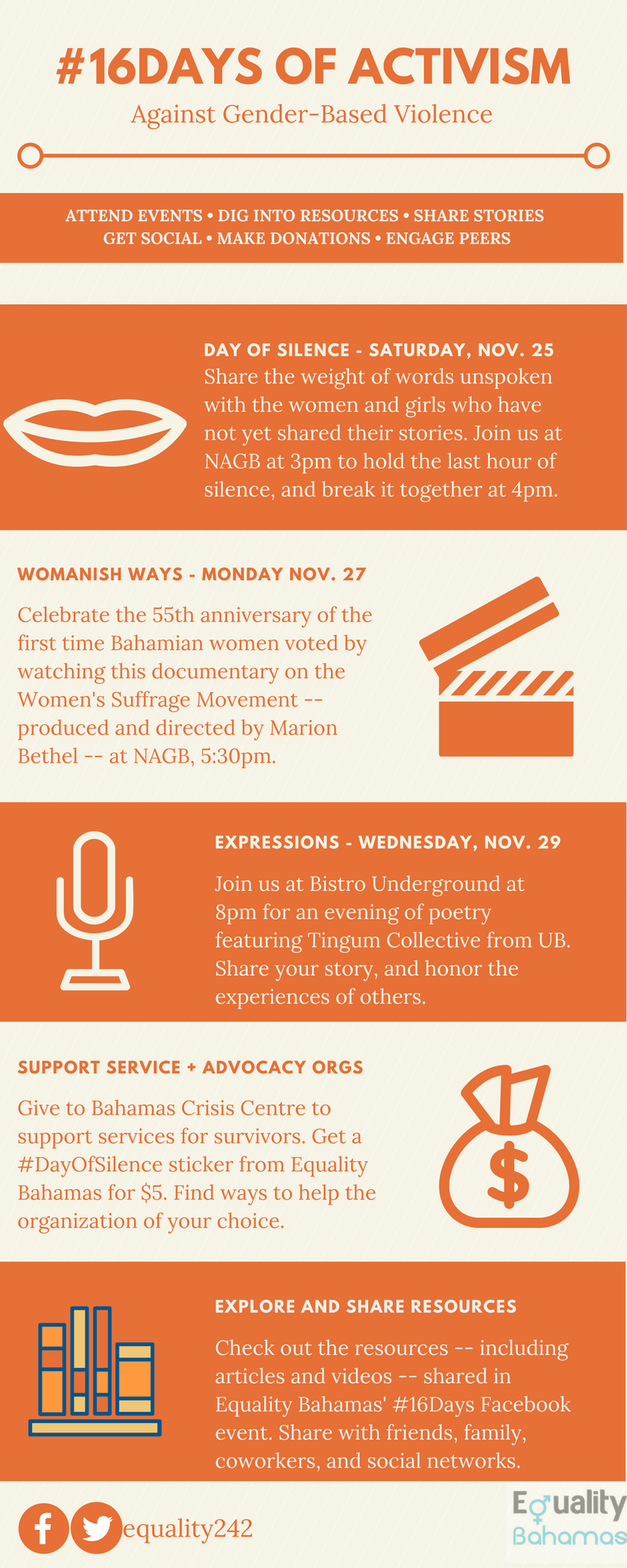
Every year, 16 Days of Activism Against Gender-based Violence — a global campaign — run from November 25 to December 10. It opens on the Day for the Elimination of Violence Against Women and closes on International Human Rights Day. These observations underscore both the pervasive and possibly most easily identified forms of gender inequality and the recognition of women’s rights as human rights. This campaign coincides with National Women’s Week in The Bahamas which this year began on the fifty-fifth anniversary of the first time Bahamian women voted.

The Department of Gender and Family Affairs planned Orange Day, a church service and the information and walk-through of the CEDAW report. The Department also disseminated information on NGO-led events and initiatives, including the Zonta Says No town hall held last night and the series of events and actions organised by Equality Bahamas.

These included a Day of Silence, screening of Marion Bethel’s Womanish Ways — a documentary on the Bahamian Women’s Suffrage Movement — and open mic at Expressions at Bistro Underground being held tonight, featuring Tingum Collective from University of The Bahamas, Blue Elite dance troupe and poets Zemi Holland and Letitia Pratt.

This 16-day campaign includes a broad range of activities which are aimed at raising awareness and driving action. Beyond wearing orange and attending events in droves, it is critical we advocate for the change we need, systemically, to end gender-based violence. As Donna Nicolls, of Bahamas Women’s Watch, stated at a few events thus far during the campaign, we need to continue our action and remember that 16 days is not enough.

The campaign is beneficial for introducing people to the issues, increasing and deepening understanding of those issues and connecting with organisations and individuals working on women’s rights and ending gender-based violence year-round all over the world.

Last year, the Life in Leggings movement started in Barbados, swept across the region and encouraged many Bahamian women to share their stories of sexual violence. For most of them, it was the first time they had spoken about their experiences.

While the campaign was not launched as a part of the 16-day campaign, it connected thousands of Caribbean women and highlighted the similarity of stories, laws and systemic issues. This year, just before the beginning of the campaign, people in Guyana stood in support of high school girls who reported sexual violence by a teacher and rebuked the headmistress who shamed girl students for not supporting their teacher. They pushed for a response from the Ministry of Education with regard to the teacher and the headmistress. It is clear none of us can wait for annual campaigns, nor can we limit our advocacy and activism to these limited periods.

Everyone is not able to participate in global campaigns or contribute to ongoing work in the same ways, so it is important to consider various levels of involvement, time commitment, and frequency of activity. As the holidays approach and the season of giving makes us more willing to part with money, think about how can you support an organisation advocating for the rights of women or providing support to women and girl survivors of violence.

While money is always helpful, a phone call or email to find out about items needed is always welcome. The Bahamas Crisis Centre, for example, is currently in need of nonperishable food including noodles, tuna, corned beef and small packs of rice.

Whether you can give a can of tuna or a case of tuna, it would be appreciated by both the organisation and its clients.

There are always people who want to help, but are not able to give tangible items, and there is space for them too. Bahamas Sexual Health and Rights Association (BaSHRA) is running Baby Can Wait — a comprehensive sexual education program — in a few high schools this academic year and could certainly benefit from more volunteers willing to be trained and assigned a class to teach for one hour per week for ten weeks. There are many ways to take action and Equality Bahamas is sharing a new idea every day during 16-days.

The first step is to think about violence in its various forms, where it shows up in your life and how you respond to it. Every act of violence is not intentional, but is still wrong, so it is on the individual, along with organisations, to be intentional in our actions and inclusion of women and girls and all other marginalised people.

Published in Culture Clash — a weekly column in The Tribune — on November 30, 2017

Prime Minister Dr Hubert Minnis announced last week the current administration will amend legislation in order to allow Bahamian women to automatically transfer citizenship to their children at birth in the same way Bahamian men already do. At present, children born to Bahamian women and non-Bahamian men outside of The Bahamas must apply for Bahamian citizenship between the ages of 18 and 21, and registration as a Bahamian citizen is at the discretion of the Minister.

The Bahamas Nationality Act — not the Immigration Act — speaks to the acquisition of Bahamian citizenship which, in many cases, must be granted by the Minister. By use of the word “automatically” in his statement, it appears Minnis means to amend the Bahamas Nationality Act so there is no application or, at the very least, no interference by the Minister. It is not clear how he intends to do this or the form the new process will take, but it is not “overturning” the referendum vote. Minnis has proposed a completely different action which will not have the same effect as a constitutional amendment.

Recall the conversation about the constitutional referendum of 2016. The Constitutional Commission repeatedly made the distinction between the right to automatic citizenship and the right to apply for citizenship. While bill one — specific to Bahamian women married to non-Bahamian men being able to transfer citizenship to children born outside of The Bahamas — would have made citizenship automatic if it had passed, bill two — specific to Bahamian women transferring citizenship to their non-Bahamian husbands — would have allowed for an application process that would not have guaranteed citizenship. This is an important distinction to make and understand: the right to apply for citizenship is not the same as the right to acquire citizenship.

Constitution vs. legislation

Since 2014 when the constitutional referendum was announced, some insisted the same goal — equal rights to transfer citizenship to spouses and children — could be achieved through legislation. They insisted the PLP administration, if it was serious about gender equality in citizenship, should just use the Bahamas Nationality Act to get the same results as a ‘yes’ vote in the referendum. They did not, however, acknowledge the difference between the constitution and legislation.

The constitution is supreme law. Article two states, “This Constitution is the supreme law of the Commonwealth of The Bahamas and, subject to the provisions of this Constitution, if any other law is inconsistent with this Constitution, this Constitution shall prevail and the other law shall, to the extent of the inconsistency, be void.” Legislation, such as the Bahamas Nationality Act, fits the “other law” category. This means what is written in the constitution overrides any legislation. That is why it was important to go through the referendum process, making an effort to change the constitution so gender equality in the right to transfer citizenship would exist in supreme law rather than in the Bahamas Nationality Act (which is superseded by the constitution).

What if the Bahamas Nationality Act is amended to allow children born outside of The Bahamas to Bahamian women married to non-Bahamian men to automatically access Bahamian citizenship? In theory, it would be great.

There would be no need for applications to the Minister, more paperwork going through Cabinet, or waiting for the age of 18. What if, however, there is a legal challenge? What if someone, or a group, decides it is not constitutional? If taken to court, based on Article two of the constitution, we know supreme law holds. This means Article nine — which says those “born legitimately outside The Bahamas after 9th July 1973 whose mother is a citizen of The Bahamas shall entitled, upon making application on his attaining the age of eighteen years and before he attains the age if twenty-one years… to be registered as a citizen of The Bahamas” — would carry more weight than any allowance made in the Bahamas Nationality Act.

No change the current administration makes to legislation is the final word. This is the reason the previous administration spent money and other resources on the constitutional referendum of 2016. Is it a step? Maybe. Is it a cure-all? Not at all.

Convention on the Elimination of All forms of Discrimination Against Women (CEDAW)

Many Bahamians were first introduced to CEDAW after the 2014 announcement of the constitutional referendum. CEDAW was adopted by the United Nations General Assembly in 1979 and ratified by The Bahamas in 1993. Though we have signed the convention, The Bahamas has made reservations on some Articles including 2(a) on the elimination of discrimination against women in “national constitutions or other appropriate legislation”.

This reservation exists because while Article 26 of the constitution is on protection from discrimination, it does not list sex as a prohibited ground for discrimination and cannot be changed without a simple majority vote by Bahamian citizens.

Article 54 of the constitution states changes to Article 26 — along with many others including 8, 10, and 14 which relate to transfer of citizenship and were included in the 2016 referendum — can only be made following a vote of at least three-quarters of both Houses and a simple majority of eligible Bahamian citizens.

The Bahamas also reserved on Article 9 of CEDAW on equal nationality rights including the ability to acquire, change, or retain nationality and the same rights with respect to their children’s nationality.

Both CEDAW and The Government of The Bahamas recognise the constitution as supreme law and understand the process of changing it. This is at least a part of the reason for The Bahamas’ reservation on the two Articles mentioned here, the decision to go to referendum in 2016, and the response from the Constitutional Commission to the argument that legislation would get the good done just as well.

Power of the Houses

It is critical we understand democracy, governance, law, and power. It is difficult to participate in national discussions without an understanding of the constitution, legislation and how they can be changed. Legislation is being tabled and amended on a regular basis, largely without the public’s attention, much less understanding or agreement. We need to pay more attention to what our Members of Parliament are doing, especially if they are looking to increase their own salaries.

“The People’s Time” can’t just be a snappy slogan; it needs to be a way of life. The people need to set the agenda, supervise our employees, and actively participate in democracy.

It is easy to see Minnis’ announcement as a victory for those of us who wanted a ‘yes’ vote in 2016. It is easy to become distracted by seemingly benevolent actions and to be assuaged by convincing rhetoric. We need to ask questions. What difference will legislative amendments make?

How is this administration acting to shift culture? Does the current composition of Parliament or the Senate reflect an interest in gender parity? How can we learn more about our constitution and existing legislation?

Who is the government, and who is responsible for protecting democracy? Where does the power really sit, and it is being used effectively? How have we contributed to the current political environment? Are we ready to change it?

Published in Culture Clash — a weekly column in The Tribune — on November 9, 2017

Published in Culture Clash — a weekly column in The Tribune — on October 18, 2017

‘MeToo’ — a campaign started by Tarana Burke and promoted by actor Alyssa Milano encouraging women to let people know they have experienced sexual harassment or assault has populated social media with evidence of the pervasiveness of sexual violence.

While it is empowering for some to be able to share their stories, or even say they have experienced something without naming or describing it, it is difficult for some people to see and understand.

It has sparked necessary conversations about sexual harassment and made it clear we need to clearly define the term and consider its effects.

In a 2015 survey conducted by Hollaback! Bahamas and Cornell University, 71.9 percent of respondents said they first experienced sexual harassment before the age of 15.

Seventeen percent reported their first experience of sexual harassment occurred before the age of 10.

We often think of sexual harassment as benign comments causing minimal harm if any at all, but over 50 percent of respondents were groped or fondled in 2015, and 80 percent had been followed by a man or group of men which made them feel unsafe.

Seventy-nine percent chose not to go out at night, 85 percent changed their route home, and 72 percent decided not to interact with a person as a result of street harassment.

What is sexual harassment?

Sexual harassment is any unwanted sexual advances, requests for sexual favours and includes verbal and physical acts of a sexual nature which violate dignity and/or create an intimidating and hostile environment.

It often depends on and abuses an existing power dynamic, used to coerce people in order to access or maintain employment or enrolment in educational institutions.

For example, in the workplace an owner, manager or supervisor may use their position and subsequent privileges to sexually coerce employees.

Suggestive remarks and inappropriate touching often go unreported because those experiencing sexual harassment fear being ostracized, terminated or facing discrimination at work.

Not limited to the workplace or educational institutions, sexual harassment frequently occurs in public spaces.

This is known as street harassment. From whistles and “Hey, baby” to following and groping, it is a daily experience for many. It disproportionately affects women, people of colour, differently-abled people and members of the LGBT+ community.

Generally, the more people are in a public space, the higher the frequency of street harassment, so those who walk and/or use public transportation are at a higher risk.

Why does this matter?

Sexual harassment, even when taking the form of comments and suggestions, is not harmless.

It is an act of violence. It is easy to dismiss this as an exaggeration, but it does not take long for an unwanted comment to escalate to physical aggression. Sexual violence is a spectrum, and while sexual harassment is seen as the lower end, it is not far from rape.

A sexual harasser ignores the same concepts and messages as a rapist. They impose themselves on other people.

They refuse to acknowledge or respect boundaries. They do not bother to get consent.

They are okay with making people feel uncomfortable.

They prioritize themselves.

They look for ways to exert their own power.

They do not care if the person says no or shows fear or anger.

They want to do what they want to do, no matter how it makes another person feel or impacts their life.

If a person can sexually harass someone in public, or in private where their job can be at risk, what else are they capable of?

What can they do behind closed doors, with no one to see, intervene or report?

Sexual harassment and the casual manner we respond to (or ignore) it contributes to the normalization of violence. It creates a world where people are free to do as they wish without consequence.

We assume everyone has the same experiences and interpretations of events as we do, and expect them to respond in the same ways.

We are slow to consider other points of view, and recognize the problem with predatory, violent behaviour whether or not it directly affects us.

Our failure to teach and talk about consent has manifested itself in generations and generations of people who have no spatial awareness, no understanding of boundaries and a belief they have the right to other people’s bodies.

What is the difference between a compliment and sexual harassment?

In discussions about street harassment a lot of time is always spent dissecting compliments and trying to draw a line between a compliment and harassment.

This is an exercise in futility because there is no clear, solid line.

This is obvious in the definition of sexual harassment which uses “unwanted” as a descriptor of the act. By definition, an act is deemed sexual harassment when the person on the receiving end does not want to experience it.

One person may find a comment acceptable while another does not. While one person may be flattered by a comment, another may be offended, angered, or fearful.

The difference between a compliment and sexual harassment is how the message is received.

This means we need to be mindful of other people’s feelings and pay attention to social cues.

If someone walks by quickly, avoids making eye contact, or is engaging in another conversation or activity, recognize that person as uninterested in your attempts to engage.

If you decide to offer a greeting and get no response, accept the lack of interest and move on. Resist the urge to impose yourself on another person.

If you give what you believe to be a compliment and get no response or a response you do not like, move on without taking up more time and space.

If your “compliment” has another result, something has gone wrong. Remember that compliments are about making other people feel good; not about making yourself feel good or reaping a reward.

Impact vs. intent

People often find the seemingly blurred line between a compliment and sexual harassment frustrating, especially when their focus is not on ending sexual harassment, but on their own desires.

If your “compliments” make someone cross the street, leave the office, or find other ways to put distance between themselves and you, you have had a different impact.

It is not unusual to affect people in unexpected, unintended ways. Sometimes we want to make people laugh, but offend them instead. There are times when we want to lighten the mood, but our actions only make things more uncomfortable.

At these times, our focus should not be on excusing or explaining ourselves. A message was not delivered properly, and it has affected other people.

Instead of considering our own feelings and getting lost in ideas of our rightness, this is the time to recognize the impact our actions had on the other people involved. Our impact is more important and deserving of our attention than our intent.

Bystander Intervention

Most of us have witness sexual harassment. We see people pull strangers by the arm to force conversation.

We hear whistles and kissing noises.

We see people being cornered by strangers. By not doing anything, we condone this behaviour and communicate that we don’t care what may happen next.

If we understand the importance of consent and ownership of our own bodies, it is on us to condemn acts of sexual violence.

We can do this by directly addressing the harasser, distracting them with a question (like which bus to take or directions to the nearest bank), asking others to help stop an act, and checking in with people who experience harassment in our presence.

There is always something we can do to help.

For more information on ending street harassment, visit facebook.com/hollaback242.